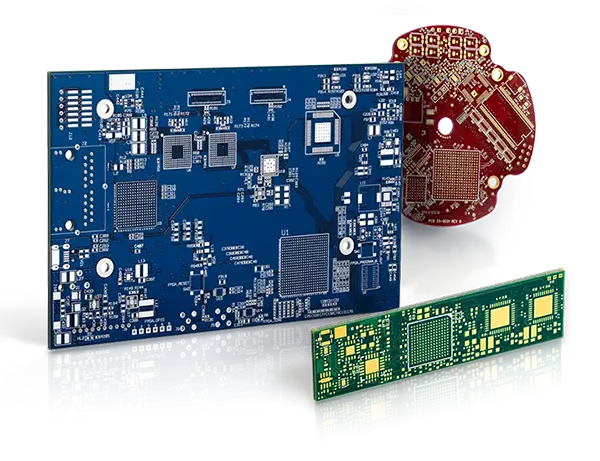

IPC-2221, IPC-6012FS, and AS9100D are the primary aerospace PCB standards that govern the design, qualification, and quality of aviation and space electronics.
Aerospace engineers should know these benchmarks to select the right materials, implement reliable layout features, and ensure traceability, data security, and regulatory compliance.
In this article, you will learn the key standards that govern aviation and space printed board design, manufacturing, testing, and certification.
Highlights:
- IPC-2221 establishes key design requirements for aerospace printed circuit boards.
- IPC-6012FS defines qualification and performance criteria for high-reliability space and military boards.
- AS9100D provides the quality management framework for fabrication and traceability.
- RTCA DO-160 and MIL-STD-810 validate performance under harsh environmental conditions.
Which IPC standards apply to aerospace and defense PCBs?
IPC-6012FS, IPC-2221/2222, and IPC class 3A are among the most important documents used for high-reliability electronics in aviation, defense, and space systems. Together, they establish the requirements to design, build, and inspect mission-critical circuit boards.
The relevant standards are listed below.
| Standard | Description |
|---|---|
| IPC-6012FS | An IPC-6012 addendum that defines class 3 requirements for space and military avionics printed boards. It specifies enhanced qualification and performance criteria to improve reliability under demanding operating conditions. This document addresses defects that occur due to thermal stress, conductive anodic filament (CAF) formation, and microvia failure. |
| IPC-2221 and IPC-2222 | Foundational standards for PCB design, covering layout practices, material selection, mechanical integrity, electrical performance, and thermal considerations. |
| IPC-TM-650 | Standardized test methods used to evaluate circuit board quality and reliability. |
| IPC class 3A | Acceptance criteria for high-reliability electronic assemblies. The class 3A addendum establishes enhanced criteria for aerospace and other mission-critical applications operating under more demanding conditions. These include tighter tolerances for hole breakouts and plating thickness. |
| IPC-6013 | Qualification and performance benchmarks for flexible and rigid-flex printed circuit boards, including material, construction, and testing. |
| IPC-A-600 | Visual acceptance criteria for bare printed circuit boards, defining acceptable and nonconforming conditions for fabrication quality. |
| IPC-A-610 | Acceptance criteria for solder joints, component mounting, cleanliness, and workmanship requirements. |
| IPC J-STD-001 | Specifications for soldered electrical and electronic assemblies, including materials, processes, inspection, and verification of soldering quality. |

IPC-6012FS supersedes earlier aerospace and defense addenda within the IPC-6012 family. Legacy documentation includes IPC-6012DS and IPC-6012ES.
For more, download the IPC Class 3 Design Guide.
IPC Class 3 Design Guide
8 Chapters - 23 Pages - 35 Minute ReadWhat's Inside:
- IPC guidelines for manufacturing defects
- IPC standards for assembly processes
- Common differences between the classes
- IPC documents to set the level of acceptance criteria
Download Now
What quality management and compliance specifications are required for space applications?
Documents such as AS9100D, AS9101E, and AS9102B establish the processes needed to manage risk, verify compliance, and maintain product traceability throughout production. Aerospace manufacturing requires rigorous quality systems that go beyond general industrial specifications.
| Standard | Description |
|---|---|
| AS9100D | Quality management system for aerospace organizations, building on ISO 9001. It provides additional guidelines for risk management, product safety, traceability, and counterfeit prevention. |
| AS9101E | Auditing requirements for assessing compliance with AS9100. |
| AS9102B | First article inspection (FAI) procedures. It is a mandatory process used to validate that the manufacturing process can consistently produce a product to specification before mass production begins. |
| AS9006A | Quality measures for software and supporting elements within aerospace systems. |
For aviation and space circuit board design guidelines, see 16 aviation and aerospace PCB design rules for high reliability.
What are the manufacturing and traceability criteria for aerospace boards?
Standards such as AMS2750E and AS478N support process control and product traceability during circuit board manufacturing. They establish requirements for thermal processing, identification marking, and lifecycle tracking to ensure consistency across production.
The relevant manufacturing and traceability criteria are listed below.
| Standard | Description |
|---|---|
| AMS2750E | Pyrometry standard for thermal processing equipment. It ensures accurate temperature control, calibration, and uniformity that support aerospace PCB manufacturing processes requiring tightly controlled thermal conditions, such as lamination and curing. |
| AS478N | Identification marking methods for aerospace components to support identification and traceability throughout the manufacturing process and product lifecycle. |
For more details on manufacturing and traceability requirements, book a meeting to talk to a PCB expert or call us at +1 (800) 763-7503.
What supply chain and component integrity standards support aviation systems?
AS5553A, NASA EEE-INST-002, and MIL-STD-883 help address counterfeit prevention, component screening, and long-term reliability in mission-critical electronics.
The key supply chain and component integrity standards are listed below.
| Standard | Description |
|---|---|
| AS5553A | Avoidance of counterfeit electronic parts within the supply chain. It is a major concern in long-lifecycle aerospace programs. |
| NASA EEE-INST-002 | Guidelines to ensure the reliability of electrical, electronic, and electromechanical (EEE) components used in space environments. |
| MIL-STD-883 | Test methods and screening procedures for microelectronic devices used in military and aerospace systems, including environmental, mechanical, and reliability testing. |
Are you worried about getting low-quality/counterfeit components, price inflation, and inefficient inventory management? We got you covered. Sierra Circuits’ customer-owned inventory services (COIN) is a personalized component sourcing and stocking program designed to meet your specific needs.
With COIN, we procure and store the required parts for your PCBAs, eliminating the risk of counterfeit or low-quality components while ensuring you have access to the necessary parts when you need them.
See our FAQs on COIN services.

Which defense and environmental qualification standards are applicable to aerospace electronics?
MIL-PRF-31032, MIL-STD-461, MIL-STD-810, and RTCA DO-160 establish electromagnetic compatibility (EMC) and environmental testing requirements in military and aerospace boards.
The relevant qualification and testing standards are listed below.
| Standard | Description |
|---|---|
| MIL-PRF-31032 | Qualification and performance requirements for military-grade printed circuit boards. |
| MIL-PRF-55110 | Construction and reliability criteria for rigid PCBs, including single-sided, double-sided, and multilayer designs. |
| MIL-STD-461 | EMC criteria for preventing interference between electronic systems. |
| MIL-STD-810 | Environmental testing procedures, including vibration, shock, humidity, and temperature exposure. |
| RTCA DO-160 | Environmental testing standards for airborne equipment, validating performance under real-world aerospace conditions. |
For more on mil-grade circuit boards, see 5 military-grade PCB design rules and considerations.
Which NASA workmanship standards apply to space and aviation PCBAs?
NASA-STD-8739.1, NASA-STD-8739.3, and NASA-STD-8739.4 establish workmanship requirements for assembling and inspecting spaceflight electronics. They provide detailed guidance for soldering, conformal coating, and wiring.
The applicable workmanship standards are listed below.
| Standard | Description |
|---|---|
| NASA-STD-8739.1 | Requirements for soldered electrical connections, ensuring high-quality assembly and inspection practices. |
| NASA-STD-8739.3 | Specifications for the application and inspection of conformal coatings used to protect electronic assemblies. |
| NASA-STD-8739.4 | Criteria for crimping, cable assemblies, harnesses, and wiring used in aerospace and spaceflight systems. |
At Sierra Circuits, we build circuit boards compliant with IPC, ISO, mil-spec, and ITAR standards.
To learn more, see aerospace and defense PCB capabilities.
What are the primary regulatory bodies and certification requirements for aerospace systems?
The Federal Aviation Administration (FAA), International Traffic in Arms Regulations (ITAR), and RTCA DO-254 are among the important regulatory and certification frameworks.
Aerospace PCBs must comply with regulations enforced by global aviation authorities. They must also adhere to design assurance standards that support the certification of safety-critical airborne electronic hardware. Depending on the application, export control regulations may also apply.
The table below lists the key regulatory bodies and certification requirements.
| Regulation/standard | Description |
|---|---|
| Federal Aviation Administration | Regulates the certification of aerospace products in the United States under FAR Part 21 and related regulations. Requires compliance with:
Emphasizes safety, reliability, and traceability, requiring adherence to established aerospace standards and thorough certification processes. |
| International Traffic in Arms Regulations | U.S. export control regulations governing the manufacture, export, transfer, and handling of defense-related articles, technical data, and services. Aerospace and defense PCB manufacturers should implement controls for data security, access management, and supply chain compliance. |
| RTCA DO-254 | Provides design assurance guidance for airborne electronic hardware. Establishes requirements for the development, verification, validation, and configuration management of safety-critical electronic systems, including those incorporating FPGAs and ASICs. Widely used to demonstrate compliance during certification of airborne electronic hardware. |
Aerospace PCB standards represent the highest level of reliability in electronics engineering. From initial design through manufacturing, testing, and certification, these standards ensure that circuit boards can endure extreme environments while maintaining consistent performance.
Compliance is not just a regulatory requirement; it is fundamental to achieving safety, reliability, and mission success in aerospace systems.