
To manage end-of-life (EOL) and obsolete (OBS) PCB components effectively, designers and procurement engineers must assess sourcing risks and qualify alternate components early.
In complex assemblies with large BOMs, the unavailability of even a single component can delay production schedules, halt assembly lines, or require engineering teams to identify alternatives.
In this article, you’ll learn the difference between EOL and OBS parts, how they affect circuit board production, and practical strategies to manage component lifecycle risks.
Highlights:
- Electronic components typically have 4 lifecycle stages: introduction, growth, maturity, and decline.
- EOL indicates that a component is available only for a defined period before discontinuation.
- Always select components with stable lifecycles to avoid sourcing risks.
End-of-life vs. obsolete PCB components
The two terms are often used interchangeably, but they describe different lifecycle events. The differences are summarized in the table below.
| Parameters | End-of-life (EOL) | Obsolescence (OBS) |
|---|---|---|
| What it means | A component that the manufacturer plans to discontinue soon, but will remain available for a limited time. | A part that is no longer available through the component manufacturer. |
| Key driver | Technology changes, product strategy, and declining demand. | Market shifts, supply constraints, and lifecycle aging. |
| Notice period | Communicated through a formal product change notice (PCN) or EOL announcement. | Identified through lead-time spikes, stock depletion, or not recommended for new designs (NRND) status. |
Circuit board assemblies often remain in service for many years, especially in industrial, medical, and telecom applications. As a result, you must manage OBS and end-of-life as separate but interconnected lifecycle events.
What are the lifecycle stages of electronic components?
Electronic components typically move through 4 lifecycle phases: introduction, growth, maturity, and decline.
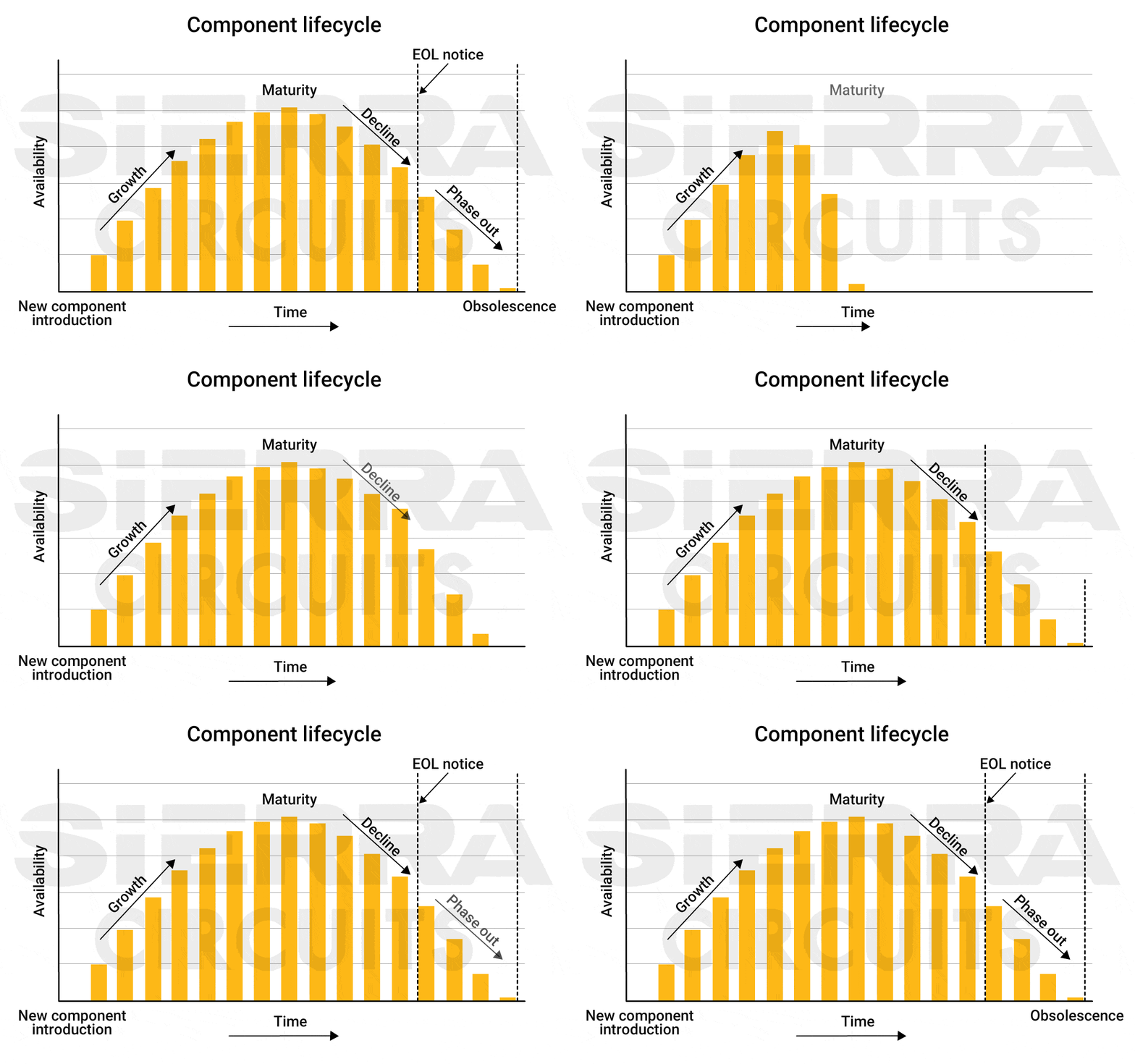
During the early stages, components are widely available and actively promoted for new designs. As newer technologies emerge, components gradually transition toward the decline phase.
Manufacturers often signal this transition by marking a component as not recommended for new designs (NRND), indicating that the part remains available; however, it should no longer be used in new products. As demand continues to decrease, the manufacturer may issue a last time buy (LTB) notice, giving customers a final opportunity to purchase remaining inventory before production stops.
EOL is formally declared during or after the decline phase, signaling the end of manufacturing. Here’s an example of an end-of-life issued by a part manufacturer.
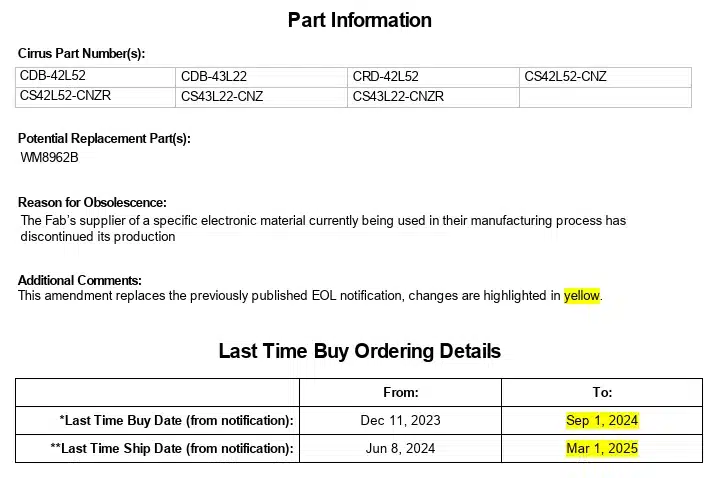
The highest obsolescence risk occurs during the decline phase, often before official end-of-life notices are issued. OEMs that monitor this lifecycle can proactively qualify alternates before supply becomes constrained.
Use Sierra Circuits’ Component Selector to quickly select the right parts for your design.

How do EOL and obsolete parts impact product maintenance costs?
End-of-life and obsolescence increase lifecycle costs by elevating inventory risk, forcing redesigns, disrupting service operations, and extending long-term support obligations.
Electronic products transition into legacy systems over time, primarily due to component obsolescence or formal EOL notices. Consumer electronics are typically replaced, but complex systems with multiple PCBAs, subsystems, firmware, and custom electronics must be maintained.
As critical parts become unavailable, maintaining long-lifecycle printed boards introduces additional expenses for the product developers.
| Support area | Cost impact | Cost drivers |
|---|---|---|
| Spare boards | High | Inventory and storage |
| Replacement components | High | Premium pricing and counterfeit risk |
| Field repair and maintenance | Medium | Labor, training, and travel |
| Engineering support | Very high | Redesign, testing, and regulatory certification |
| Firmware and system support | Medium | Staffing and toolchain updates |
These costs are well known in industries where equipment lifespans extend over multiple decades, and they often increase gradually over time.
7 strategies to manage EOL and obsolete components
The following are some of the strategies that PCB designers and procurement engineers can implement to counter end-of-life and obsolete electronic components:
1. Proactively assess sourcing risks
Select components with stable lifecycles and avoid single-source parts where possible. The procurement team should verify sourcing options and long-term availability during part selection.
2. Choose lifecycle-stable components
During component selection, designers should prioritize parts that are widely used across the industry and supported by multiple suppliers. Components with long production histories and large market adoption are less likely to be discontinued early, reducing future redesign risks.
3. Implement continuous lifecycle monitoring
Sourcing teams should track PCNs, NRND notices, and lifecycle status for parts used in the BOM. They should also review distributor data and identify potential supply risks early.
4. Maintain a standardized part library and an approved vendor list
Procurement experts should maintain an approved vendor list (AVL), while designers must develop standardized component libraries to enable quick substitution of equivalent parts from qualified suppliers when availability changes.
5. Establish formal OBS and EOL review practices
Include component lifecycle checks as part of design reviews and BOM validation. Sourcing teams should conduct periodic bill of materials checks to identify components approaching NRND, EOL, or obsolescence, and flag high-risk parts before production.
6. Plan last time buys with procurement teams
When a component approaches EOL, the procurement team should review LTB announcements. Evaluate whether stocking parts or redesigning the circuit board is the best long-term option.
7. Identify alternate components and contingency plans
Design engineers should evaluate and qualify alternate parts during the layout stage whenever possible. Procurement engineers should confirm compatibility and availability to reduce redesign risks later.
Sierra Circuits manufactures and assembles high-quality standard and advanced circuit boards.
To learn more, talk to a PCB expert: Book a meeting or call us at +1 (800) 763-7503.
How to check OBS status on distributor websites
Authorized distributor platforms provide early visibility into component status changes, including NRND, EOL notifications, and LTB deadlines.
To verify a component’s lifecycle status:
- Search by manufacturer part number (MPN): Always use the exact MPN to avoid confusion with similar variants or package options.
- Review lifecycle indicators: Most distributors label parts as active, NRND, or obsolete. NRND often signals elevated risk before formal discontinuation.
- Check product change notifications (PCNs): Manufacturing process updates can signal upcoming product obsolescence.
- Identify last-time buy deadlines: Confirm final order and shipment dates to support structured LTB planning.
- Cross-reference the part manufacturer’s website: The original component manufacturers (OCM) provide the authoritative lifecycle declaration.
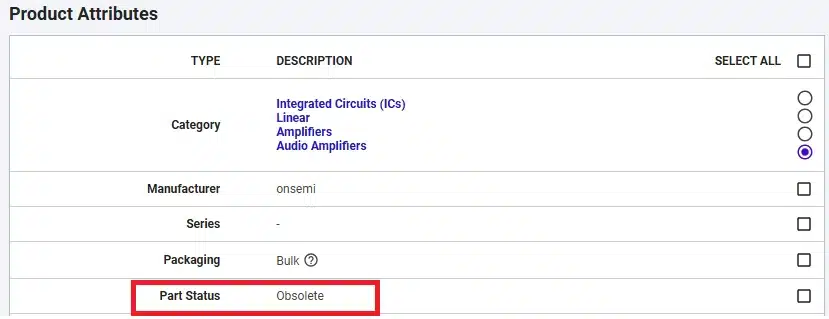
For example, on the DigiKey website, enter the manufacturer part number and review the status field on the product page. This indicates whether the component is active, NRND, last time buy, or obsolete, and may include links to available PCN or end-of-life documentation.
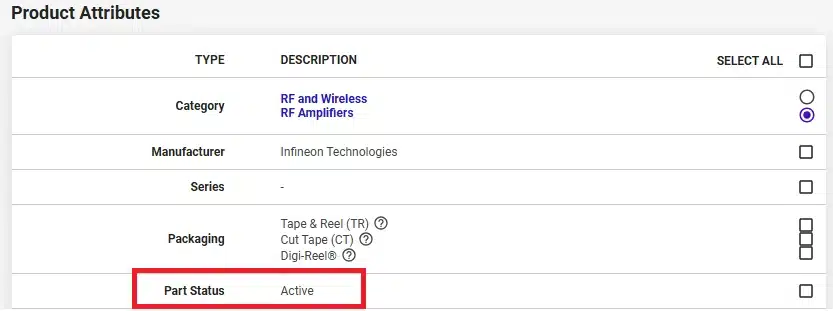
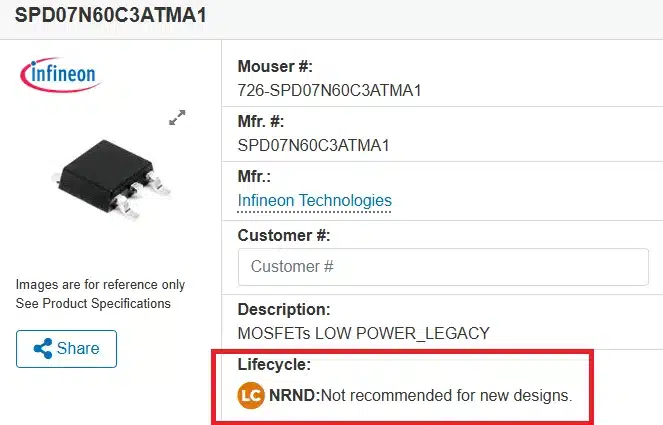
On Mouser Electronics, search by the MPN and review the lifecycle label displayed on the product detail pages. Mouser flags NRND and obsolete components and provides access to manufacturer-issued PCNs when available.
Routine lifecycle verification at both distributor and manufacturer levels reduces unexpected supply disruption and supports proactive alternate qualification.
To eliminate component sourcing risks, opt for Sierra Circuits’ COIN services. Here, we source, verify, and manage parts required for your PCBAs. We also provide a shortage reports that highlight inventory gaps against current availability.
Electronic component obsolescence is not just a supply chain issue; it is a cross-functional business risk that impacts engineering, operations, finance, and customer commitments.
With proactive forecasting, structured governance, engineering decisions, and disciplined procurement, you can overcome the risks associated with EOL and obsolete PCB components.
To learn how to avoid assembly delays, download the Design for Assembly Handbook.
Design for Assembly Handbook
6 Chapters - 50 Pages - 70 Minute ReadWhat's Inside:
- Recommended layout for components
- Common PCB assembly defects
- Factors that impact the cost of the PCB assembly, including:
- Component packages
- Board assembly volumes