



Contents

On-demand webinar
How Good is My Shield? An Introduction to Transfer Impedance and Shielding Effectiveness
by Karen Burnham
PCB manufacturing costs are typically lower in China than in the USA due to reduced labor expenses and large-scale production capacity. These factors reduce operating expenses, resulting in lower unit prices compared to U.S. production.
American board manufacturers offer advantages that can make up for the higher price. This includes faster turnaround times, stronger quality control, closer collaboration with engineers, and more reliable intellectual property protection.
For prototypes, complex builds, or time-sensitive projects, domestic manufacturing can offer better overall value, even if the upfront cost is higher.
In this article, you’ll learn the real reasons behind the pricing differences and situations where US production is still a better choice.
Highlights:
- China dominates high-volume printed board manufacturing due to scale, automation, and government-backed industrial investment.
- US circuit board fabricators specialize in ITAR, quick-turn, and complex hybrid constructions.
- Cost differences are driven by labor, environmental compliance, equipment utilization, and supplier pressure.
- Domestic fabrication often provides faster engineering support and better communication.
Global circuit board manufacturing landscape
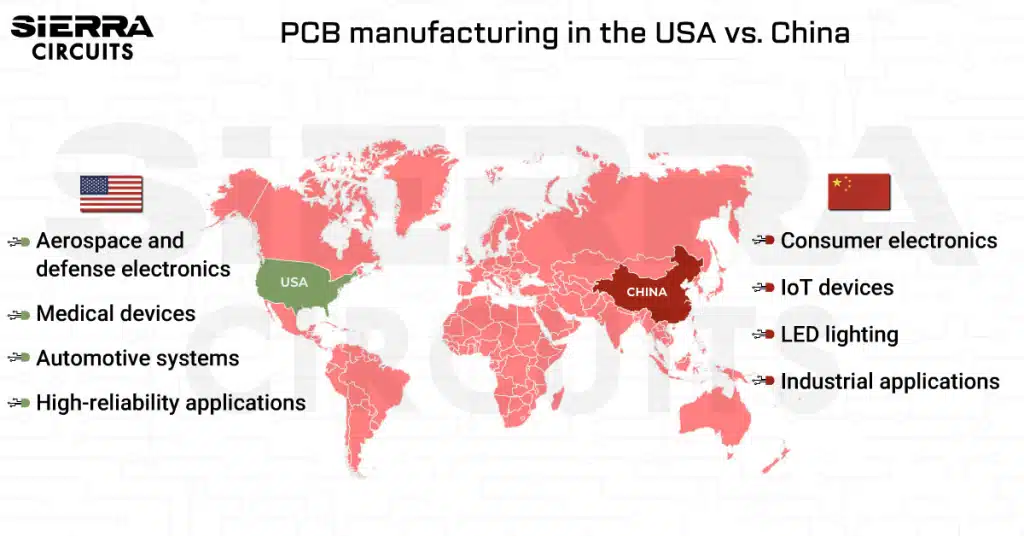
Asia produces most of the world’s printed circuit boards, with China accounting for a large share of total global output. Large industrial clusters in regions such as Shenzhen, Guangzhou, and Suzhou support dense supplier networks that include laminate manufacturers, chemical suppliers, fabrication facilities, and electronics assembly plants.
While Asia dominates global PCB output, the United States still remains a major hub for high-reliability and advanced fabrication. Production in the US is concentrated in California, Arizona, Texas, Minnesota, Illinois, Oregon, and the Northeast.
USA focuses heavily on:
- Aerospace and defense electronics
- Medtech
- Industrial control systems
- Advanced research and prototyping
- High-reliability applications
These industries prioritize traceability, compliance, and efficient engineering collaboration rather than the lowest possible unit cost. Understanding this market structure explains why the price gap exists and why each region excels in different use cases.
For design for manufacturing strategies, download the DFM Handbook.
Design for Manufacturing Handbook
11 Chapters - 96 Pages - 90 Minute ReadWhat's Inside:
- Annular rings: avoid drill breakouts
- Vias: optimize your design
- Trace width and space: follow the best practices
- Solder mask and silkscreen: get the must-knows
Download Now
Why are PCBs built in China cheaper than in the U.S?
PCBs made in China cost less than US-made because Chinese fab houses benefit from lower labor costs, large-scale production, and tightly integrated supply chains that reduce overall expenses.
Factors that contribute to this cost advantage include:

1. Volume-driven production model
Steve Carney, R&D Project Manager at Sierra Circuits, says,
“The biggest thing there is the sheer volume of it. Everything is highly automated in China, and labour is less. Equipment operates continuously, often across multiple shifts, and fixed costs are distributed across millions of units. If your order size is large and stable, this model significantly reduces unit pricing.”
For example, a consumer IoT PCB product shipping 1 million units annually can achieve substantially lower board costs through high-volume Asian fabrication.
In comparison, US facilities typically handle lower-volume production, multiple simultaneous projects, and complex engineering-focused builds. Smaller production runs increase per-unit cost since setup, tooling, and process calibration must be repeated frequently.
Chinese fab houses often combine multiple designs onto shared printed board panels to maximize material usage. This practice reduces waste and lowers manufacturing costs.
US manufacturers usually dedicate panels to individual jobs, particularly for high-reliability or controlled processes. This improves traceability but increases material consumption.
2. Labor costs and workforce structure
Labor is one of the most obvious contributors to PCB pricing. Manufacturing wages in China remain lower than those in the United States, even after steady increases over the past decade. Circuit board fabrication involves multiple labor-intensive steps, such as:
- Panel handling and setup
- Circuit board surface finish processes
- Quality inspection
- Packaging and logistics preparation
Automation has improved in both countries; human involvement is still necessary for supervision, inspection, maintenance, and process control.
In the United States, skilled manufacturing technicians command higher wages. On top of that, employers also cover benefits, insurance, retirement contributions, and regulatory compliance costs, which further increase overall expenses.
3. Equipment investment and utilization efficiency
Board fabrication requires expensive machinery, such as:
- Laser drilling systems
- Imaging equipment
- Plating lines
- AOI systems
- Electrical test machines
Large Chinese factories often purchase equipment in bulk and operate machines continuously across multiple shifts. High utilization spreads equipment costs over a larger output volume, reducing the cost per board.

On the other hand, US-based manufacturers often invest heavily in advanced capabilities such as:
- Controlled impedance fabrication
- Aerospace-grade quality systems
- High-speed material processing
- Traceability infrastructure
These specialized investments increase operating expenses and are reflected in pricing.

4. Market focus and production priorities
The types of boards handled by fab houses strongly influence pricing structures. China primarily focuses on commercial and consumer electronics.
Many Chinese PCB factories primarily serve:
- Consumer electronics
- IoT devices
- LED lighting
- Industrial electronics
- Automotive subsystems
These markets emphasize cost efficiency and high production volumes. Manufacturing lines are optimized for rapid throughput and price competitiveness.
The US focuses on high-reliability sectors such as defense, aerospace, medtech, and automotive.
5. Government policies and industrial support
National policies play a major role in manufacturing competitiveness. Chinese local governments frequently support electronics manufacturing through:
- Tax incentives
- Reduced land lease costs
- Infrastructure investment
- Export support programs
These measures reduce operating costs and enable Chinese fab houses to offer competitive prices in global markets.
American manufacturers must comply with strict regulations covering:
- Workplace safety standards
- Environmental protection rules
- Waste management
- Chemical handling regulations
These regulations improve worker safety and environmental outcomes; they also increase production costs. Compliance requires specialized systems, documentation, and inspections.
US factories maintain a large investment in waste treatment, which raises operating costs. However, this supports environmental safety and process stability.
Chinese factories also follow environmental rules, but enforcement levels and operational costs can differ by region.
6. Currency exchange and global pricing strategy
Currency value plays a subtle but important role in PCB pricing. When the Chinese yuan is weaker relative to the US dollar, Chinese exports become more affordable for international buyers.
Even small currency fluctuations can impact the costs in global contracts.
In addition, many Chinese fabricators prioritize export growth to maintain high factory utilization. Competitive pricing helps them secure international customers and keep production lines running at scale.
Manufacturers in the United States typically prioritize margin stability and long-term customer relationships rather than aggressive global price competition.
Hidden risks of choosing offshore printed board manufacturers
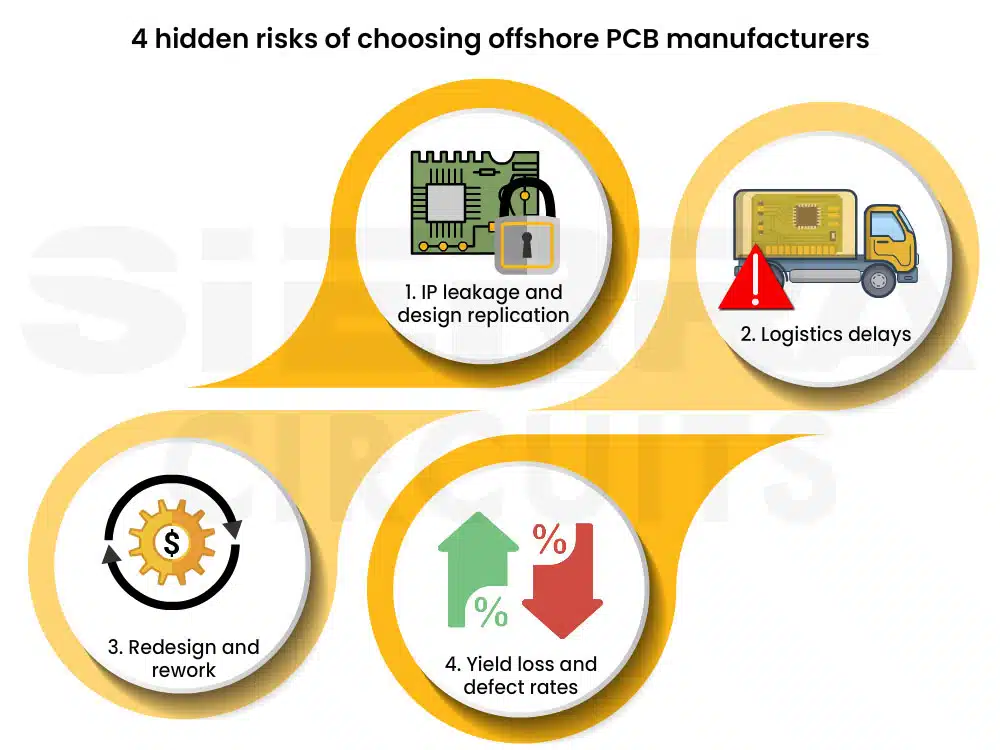
Offshore board fabrication may offer attractive unit pricing, but several hidden risks can significantly impact total cost, schedule stability, and intellectual property security. These risks are listed below:
1. Design replication and IP leakage
Projects involving proprietary design, defense electronics, or patented technologies require strict control over production files. In offshore manufacturing environments, you may face higher concerns around intellectual property enforcement, data handling transparency, and subcontractor visibility.
Shared production lines, or unauthorized file access, can increase the risk of design replication and IP leakage. For security-critical programs, many organizations prefer CMs with strong IP laws and traceable data controls to minimize exposure.
FYI, aerospace and defense PCBs must comply with ITAR. These projects come with a no-fly tag and must be designed and built in the USA. For more details, see what is ITAR, the international traffic in arms regulations?
2. Shipping and logistics delays
Long transit times can delay product launches and increase inventory holding costs. Customs clearance, port congestion, or international shipping disruptions can further extend delivery timelines.
In time-sensitive industries, even a small delay can disrupt assembly schedules and market commitments.
3. Redesign and rework expenses
Miscommunication or manufacturability issues can cause expensive iteration cycles. Time zone differences and limited real-time engineering interaction can slow down the required communication between the design engineers and the manufacturing unit, resulting in delayed turn time.
If DFM feedback is delayed or is incomplete, boards may require respins, adding fabrication, shipping, and engineering costs.
For more on design for manufacturing and assembly, see top DFM and DFA mistakes that delay your PCB production.
4. Yield loss and high defect rates
Lower yield can increase the effective per-unit cost even if the initial fabrication price is lower. Quality inconsistencies may lead to higher rejection rates during inspection or assembly.
Debugging defective boards also consumes engineering time and delays validation schedules. When failures occur in the field, warranty replacements and reliability risks further increase the total lifecycle cost.
Comparing quotes only by unit price can be misleading. A full sourcing decision should consider the total lifecycle cost. When you consider the above factors, domestic manufacturing can beat overseas pricing.
To learn how to avoid assembly delays, download the DFA Handbook.
Design for Assembly Handbook
6 Chapters - 50 Pages - 70 Minute ReadWhat's Inside:
- Recommended layout for components
- Common PCB assembly defects
- Factors that impact the cost of the PCB assembly, including:
- Component packages
- Board assembly volumes
Download Now
When to choose China for board fabrication and assembly
China is typically preferred under the following circumstances:
| Condition | Why China makes sense |
|---|---|
| Volume ≥ 25,000 units | Significant unit cost reduction |
| Stable design (no frequent revisions) | Better manufacturing efficiency for repeat builds |
| Standard materials (FR4) | Easily scalable production |
| Consumer electronics | Optimized supply chain |
When to choose the United States for PCB manufacturing and assembly
US manufacturing is a strong choice under the following circumstances:
| Condition | Why the US makes sense |
|---|---|
| Prototype phase | Fast iteration cycles and closer engineering collaboration |
| Frequent design changes | High flexibility |
| Complex hybrid stack-ups | Advanced material expertise and better manufacturability support |
| Regulated industries | Robust compliance, traceability, and documentation systems |
| IP sensitivity | Stronger legal protection |
| Quick-turn requirement | Shorter lead times |
PCB production cost in the USA vs. China
Before deciding between the United States of America and China, evaluate:
- What is the forecast production volume?
- How stable is the design?
- Does the stack-up include hybrid or RF materials?
- Are revisions expected within 6 months?
- Is IP protection critical?
- Is time-to-market a competitive factor?
If flexibility and iteration speed matter more than the unit price, domestic production may reduce overall project risk.
The table below summarizes the key differences between printed board manufacturing in China and the United States.
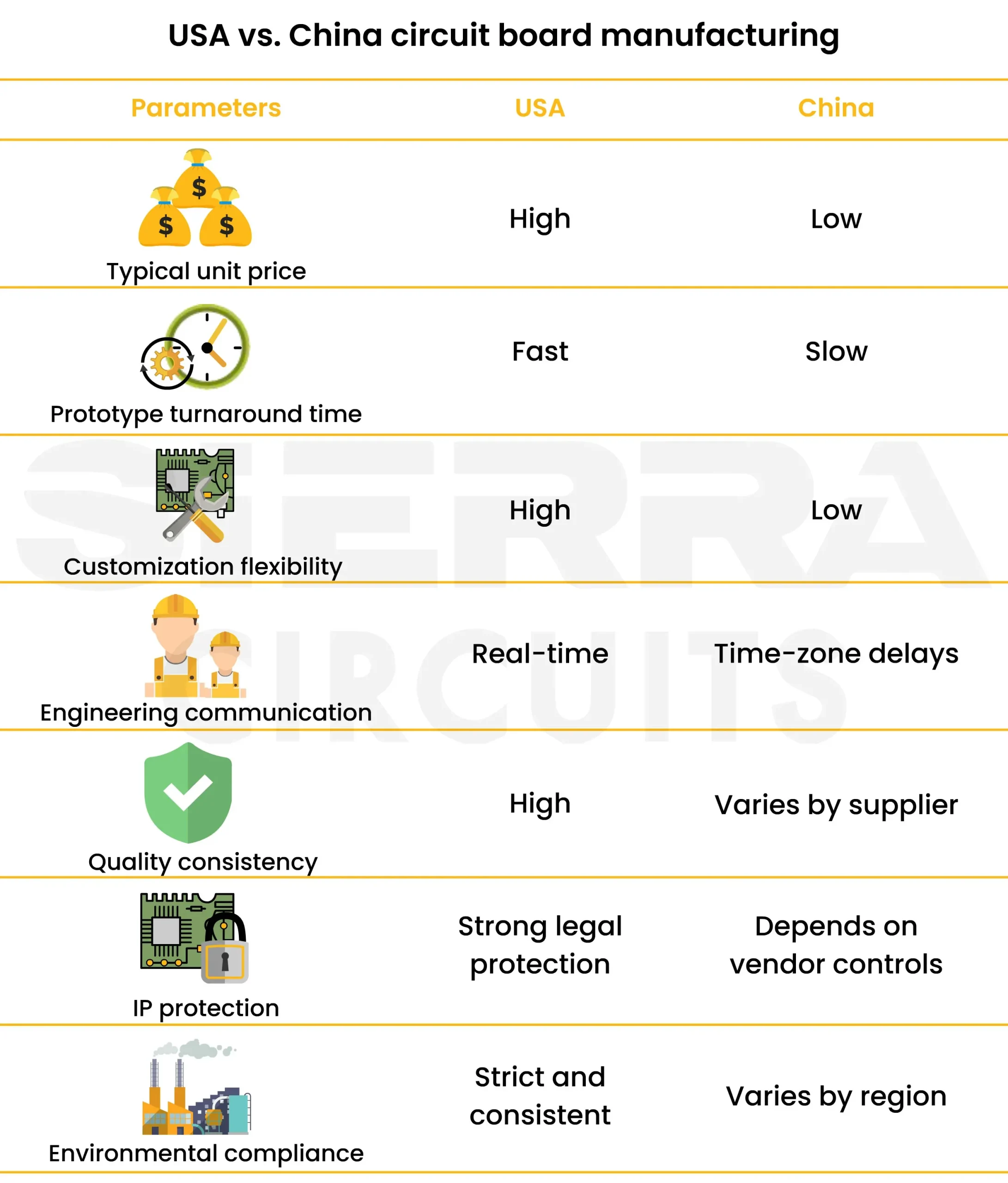
7 reasons to build your board in the USA
Chinese manufacturers are often known for competitive pricing. However, US fabricators provide distinct advantages, especially for high-reliability, complex, and engineering-intensive projects.

Here are the benefits of choosing a US-based fab house:
1. Customizations and build flexibility
China’s printed board fabricators are often more focused on high-volume production and less responsive to customization.
US fab houses often specialize in:
- Quick-turn prototypes
- Complex HDI builds
- Hybrid stack-ups
- Engineering-heavy projects

2. Higher quality control
US fabricators typically follow strict quality systems and certification standards, including:
- ISO quality management systems
- IPC manufacturing standards
- Industry-specific certifications such as AS9100 or ISO 13485
American facilities invest in:
- Automated optical inspection systems
- X-ray verification
- Electrical testing processes
- Process traceability systems

This level of control reduces variability and supports industries where failure risk must be minimized.
3. Faster turnaround for prototypes and reduced logistics risk
Domestic production eliminates international shipping delays and customs clearance steps.
Advantages include:
- Quick-turn prototypes delivered in days
- Reduced transport uncertainty
- Simplified tracking
- Lower risk of customs delays
This reliability can be essential for projects with tight deadlines.
4. Easier engineering collaboration
Real-time communication with the US manufacturers supports:
- Immediate design clarification
- Faster DFM feedback
- Rapid circuit board stack-up adjustments
- Quick troubleshooting
Time zone alignment and direct access to engineers improve efficiency, especially for complex designs.
If a cheaper offshore batch results in higher defect rates or delayed delivery, the total program cost may exceed the domestic option.
5. Strong intellectual property protection
Domestic manufacturing provides:
- Stronger legal enforcement mechanisms
- Standard confidentiality agreements
- Secure data management practices
- Reduced risk of unauthorized design replication
For companies with proprietary technology, this assurance can outweigh cost savings from offshore production.
At Sierra Circuits, we build printed boards compliant with IPC, ISO, mil-spec, and ITAR standards.
To learn more, talk to a PCB expert: Book a meeting or call us at +1 (800) 763-7503.
6. Greater supply chain resilience
Recent global disruptions have highlighted risks in extended supply chains, including:
- Tariff uncertainty
- Geopolitical tensions
- Shipping disruptions
- Component shortages
Domestic fabrication can improve:
- Production control
- Inventory planning
- Responsiveness to market changes
This shift is especially noticeable in industries requiring reliable delivery schedules.
To eliminate component sourcing risks, opt for Sierra Circuits’ COIN services. Here, we source, verify, and manage parts required for your PCBAs. We also provide a shortage reports that highlight inventory gaps against current availability.
7. Rapid troubleshooting for assembly issues
Assembly issues frequently need quick investigation and resolution. Common challenges include:
- Part shortage
- Component footprint or stencil adjustments
- Soldering profile tuning
- Test fixture updates
Domestic assembly can simplify:
- Component management
- Real-time engineering discussions
- Quick on-site inspections
- Immediate corrective actions
This supports faster development cycles, especially during early product stages.

Consider the PCB manufacturer, not just the country
Comparing the PCB cost in China and the USA is important, but geography alone doesn’t determine board quality or project success.
Quality, reliability, and engineering support mainly depend on the individual PCB manufacturer, not the region. A careful evaluation of a supplier’s capabilities, processes, and track record matters more than geography.

Evaluate potential fabricators using the following criteria:
Certifications
Look for:
- ISO and IPC compliance
- Industry-specific certifications
Technical capabilities
Check:
- Minimum trace and spacing limits
- Maximum supported layer count
- High-speed material processing capability
- Controlled impedance tolerances
Engineering support and DFM guidance
Reliable fab houses offer:
- DFM reviews
- Stack-up recommendations
- Direct access to CAM/engineering teams for technical discussions
- Design rule feedback aligned with the fab’s real process limits
- Responsive customer support
Turnaround time
Confirm whether the supplier offers:
- Quick-turn prototypes
- Standard production timelines
- Expedited manufacturing support
Pricing transparency
A reliable fabricator should clearly explain the following expenses:
- Material
- Fabrication
- Assembly
- Testing
- Shipping
Customer feedback and experience
Look for:
- Case studies
- Industry experience
- Customer testimonials
- Long-term client relationships
PCB manufacturing costs are generally lower in China than in the USA due to factors such as lower labor expenses, large-scale production capacity, dense supplier ecosystems, and government-backed manufacturing infrastructure. These advantages allow Chinese fabrication facilities to offer highly competitive pricing, particularly for high-volume production.
However, U.S. PCB manufacturers provide important benefits that often outweigh the price difference in certain situations. Domestic fabrication typically offers faster prototype turnaround, stronger quality control, better engineering collaboration, and more reliable intellectual property protection.
About the technical reviewer:
Steve Carney is an R&D Project Manager at Sierra Circuits with over 17 years of experience in printed board fabrication. He specializes in manufacturing HDI, high-speed, and other advanced circuit boards.
Need assistance building your stack-up? Post your queries on our forum, SierraConnect. Our design and manufacturing experts will help you.

About Sushmitha V : Sushmitha V has a master's degree in power electronics and has over four years of experience in the PCB industry. Her areas of interest include circuit board manufacturing, assembly, IPC standards, and DFM/DFA practices.

Start the discussion at sierraconnect.protoexpress.com