



Contents

On-demand webinar
How Good is My Shield? An Introduction to Transfer Impedance and Shielding Effectiveness
by Karen Burnham
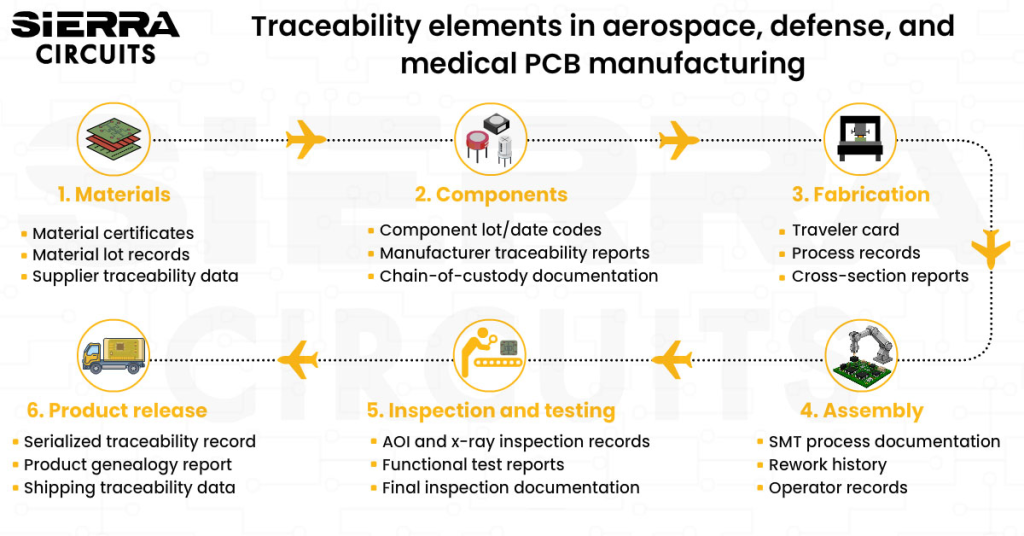
Traceability in PCB manufacturing is the ability to track and document every stage of production. This includes material sourcing, fabrication, assembly, inspection, and testing.
These reports help fab houses meet regulatory requirements, prevent counterfeit components, and investigate failures.
Board designers, hardware engineers, and quality teams should understand these specifications to ensure their products meet regulatory and customer expectations.
In this article, you’ll learn about traceability in aerospace, defense, and medical board manufacturing and the relevant documentation that engineers request from their fabricator.
Highlights:
- Medical PCBs rely on ISO 13485, device history records (DHR), IPC class 3 inspection benchmarks, and serialized manufacturing records.
- Aerospace and defense projects often include AS9100 quality systems, AS9102 first article inspection reports (FAIR), and counterfeit component controls.
- Advanced tracking systems enable component-level tracking, maintain serialized manufacturing histories, capture AOI and X-ray inspection records, and simplify root-cause analysis during failure investigations.
What is the purpose of traceability in PCB manufacturing and assembly?
Manufacturers use tracking systems to verify how a board was built, including the materials, components, manufacturing processes, inspections, and test results associated with it.
This documented history supports regulatory compliance, failure investigations, and recall management in high-reliability industries such as medical, aerospace, and defense electronics.
Unlike standard commercial electronics, these applications often require detailed records of raw materials and manufacturing processes.
The level of traceability in PCB manufacturing depends on the applicable industry standards. For instance, aerospace products typically follow benchmarks such as AS9100, along with relevant IPC class 3 standards. Medical devices should comply with ISO 13485, class 3, and relevant medical device regulations.
In addition to these baseline aerospace and defense printed board standards, engineers may often specify their own documentation needs.
According to Mahdi Emami, Senior Manufacturing Technologist at Sierra Circuits, “Traceability requirements vary by customer. They are typically defined through quality reporting and contractual specifications.”
Not all boards require the same level of visibility. Depending on the application, fabricators use either lot-level or component-level tracking to provide the required class of visibility.
Lot-level vs. component-level tracking
Traceability systems can operate at different levels depending on product complexity, regulatory standards, and customer expectations.
The two typical approaches are lot-level and component-level tracking. The table below summarizes the key differences.
| Criteria | Lot-level traceability | Component-level traceability |
|---|---|---|
| What is tracked | Material lots, date codes, and component batches linked to a work order or production run | Individual components linked to specific board serial numbers and reference designators |
| Visibility | Identifies which material lots were used in a batch, but not the exact board on which the component was assembled | Tracks exactly which component was installed on a specific PCB assembly |
| Implementation complexity | Low | High |
| Advantages | Easier to implement, lower data management, suitable for standard manufacturing workflows | Supports detailed root cause analysis, recall containment, counterfeit prevention, mission-critical reliability investigations |
| Common applications | Commercial electronics, standard industrial applications, prototype programs | Aerospace, defense, implantable medical devices, mission-critical electronics |
Commercial electronics may only require lot-level tracking, but high-reliability medical and aerospace programs often require component-level visibility and detailed manufacturing records.
To learn how to design reliable circuit boards, download the IPC Class 3 Design Guide.

IPC Class 3 Design Guide
8 Chapters - 23 Pages - 35 Minute ReadWhat's Inside:
- IPC guidelines for manufacturing defects
- IPC standards for assembly processes
- Common differences between the classes
- IPC documents to set the level of acceptance criteria
Download Now
How do serialization and process tracking work?
Many high-reliability prototypes should have a unique identifier (UID) or serial number (SN). This identifier distinguishes each board, even when multiple assemblies are manufactured in the same production lot.
As the prototype moves through manufacturing, the serial number is used to link material, process, inspection, and test records to that specific build, creating a complete manufacturing history.
Process records may include:
- SMT records
- AOI inspection data
- X-ray inspection reports
- Rework history
- Operator identification
- Process approval or sign-off records
- Machine usage
- Timestamps
- Environmental monitoring readings (temperature, humidity, cleanroom conditions, etc.)
This information supports audits, failure investigations, recall containment, and long-term product tracking.
Hoang Do, Director of Quality and Compliance at Sierra Circuits, explained, “The goal of traceability is to identify exactly which materials, components, and manufacturing activities were associated with a specific assembly, especially when investigating failures in the field.”
Some advanced tracking systems also capture work-in-process (WIP) and yield data to help identify process bottlenecks, quality issues, and the exact stage at which defects occurred.
If you want more details on traceability, book a meeting to talk to a PCB expert or call us at +1 (800) 763-7503.
What are the key traceability elements in aerospace and defense PCBs?
Fabricators generally maintain records for product identification, material and component source, manufacturing processes, configuration control, and inspections. This data supports regulatory compliance and failure investigations.
Aerospace manufacturers typically operate under AS9100 and often use IPC-1782 for electronics traceability.
In many cases, aerospace and defense projects require manufacturers to demonstrate complete visibility into how the PCB was sourced, manufactured, inspected, and verified.
The primary goal of aerospace board traceability is to quickly identify and contain quality issues. For example, if a component lot is found to be defective, fab houses must be able to identify every build that contains components from that lot and limit corrective actions to only the affected products.
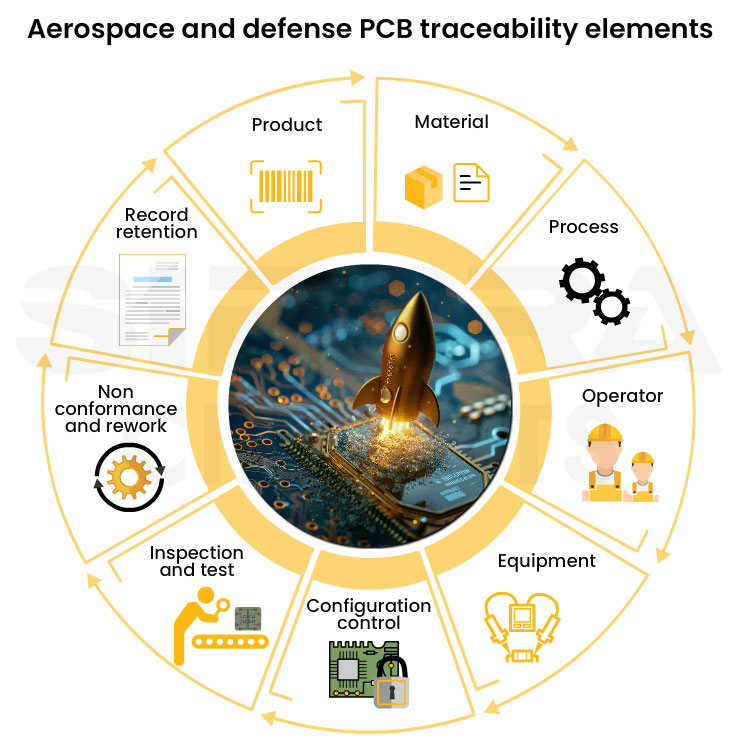
The table below summarizes the key traceability records maintained for aerospace and defense PCBs.
| Traceability elements | Description |
|---|---|
| Product | Each prototype is assigned a unique serial number or UID. |
| Materials and components | Complete material and component genealogy, including manufacturer name, manufacturer part number, lot/date code, certificate of conformity, laminate lot, solder mask lot, surface finish batch, solder paste lot, conformal coating lot, and other consumables used during production. |
| Manufacturing process | Machine programs and revision levels (CAM, AOI, X-ray, testing, etc.), process parameters, and production dates. |
| Operator | Identification of personnel who performed, inspected, verified, and approved each manufacturing and quality operation, including training and certification status wherever required. |
| Equipment | Information on equipment used during fabrication, inspection, and testing, including machine ID, calibration status, and maintenance records. |
| Configuration control | Controlled product definition, including BOM revision, circuit board fabrication drawing revision, assembly drawing revision, firmware/software revision, approved deviations or waivers, and engineering change orders (ECO). |
| Inspection and test | Inspection and test results associated with the product serial number, including AOI, X-ray, testing, and final acceptance records. |
| Nonconformance and rework | Records of defects, material review board (MRB) dispositions, rework activities, corrective actions, and verification results linked to the affected serial number. |
| Record retention | Retention of traceability records in accordance with customer, regulatory, and quality management system specifications; commonly, product life plus two years, or as contractually specified. |
To learn how to design an aerospace prototype, see 16 aviation and aerospace PCB design rules for high reliability.
What is the significance of AS9100 and AS9102 in aerospace board manufacturing?
AS9100 supports aerospace PCB traceability through documented processes, configuration control, manufacturing records, risk management, and retention of quality data throughout the product lifecycle.
The standard builds upon ISO 9001 requirements while adding additional controls related to configuration management, process visibility, risk management, product reliability, and manufacturing verification.
As a result, many aerospace OEMs expect circuit board manufacturers to maintain AS9100-certified quality systems before approving them for production.
AS9102 defines the documentation and reporting requirements for the first article inspection report. It establishes a standardized process to verify if a board was manufactured according to engineering drawings, specifications, and customer requirements before release.
FAI documentation may include:
- Dimensional measurements
- Inspection results
- Drawing verification
- Process validation records
- Manufacturing verification data
- Tooling or calibration information
In many aerospace projects, FAIR becomes a part of the overall traceability and quality documentation package delivered to the customer.
How does component genealogy support counterfeit prevention?
By maintaining complete records of component sourcing, supplier information, lot codes, and chain-of-custody documentation, manufacturers can verify component authenticity and reduce the risk of counterfeit parts entering the supply chain.
Aerospace PCB tracking often requires a documented chain of custody that includes:
- Original component manufacturer information
- Authorized distributor records
- Supplier documentation
- Purchase history
- Lot/date code
Aerospace and defense projects require manufacturers to source components only through authorized distributors or directly from original component manufacturers.
In the event of a field failure, fabricators can trace components back through the supply chain to identify potential sourcing issues or defective lots.
Some aerospace and mil-grade printed board designs may also require serialized component-level tracking to support supply chain verification, inspection traceability, and failure investigations.
Are you worried about getting low-quality or counterfeit components? We’ve got you covered. Sierra Circuits’ customer-owned inventory services (COIN) is a personalized component sourcing and stocking program designed to meet your specific needs.
With COIN, we procure and store the required parts for your PCBAs, eliminating the risk of counterfeit or low-quality components while ensuring you have access to the necessary parts when you need them.
See our FAQs on COIN services.

What are the core traceability elements for medical boards?
Medical PCB fabricators maintain records for product identification, material and component history, manufacturing processes, device master record (DMR) control, and device history record.
These documents support regulatory compliance, product investigations, recall management, and patient safety.
Medical device manufacturers typically operate under ISO 13485 and applicable medical device regulations. The standard mandates documented evidence that each board was manufactured, inspected, and tested according to approved procedures.
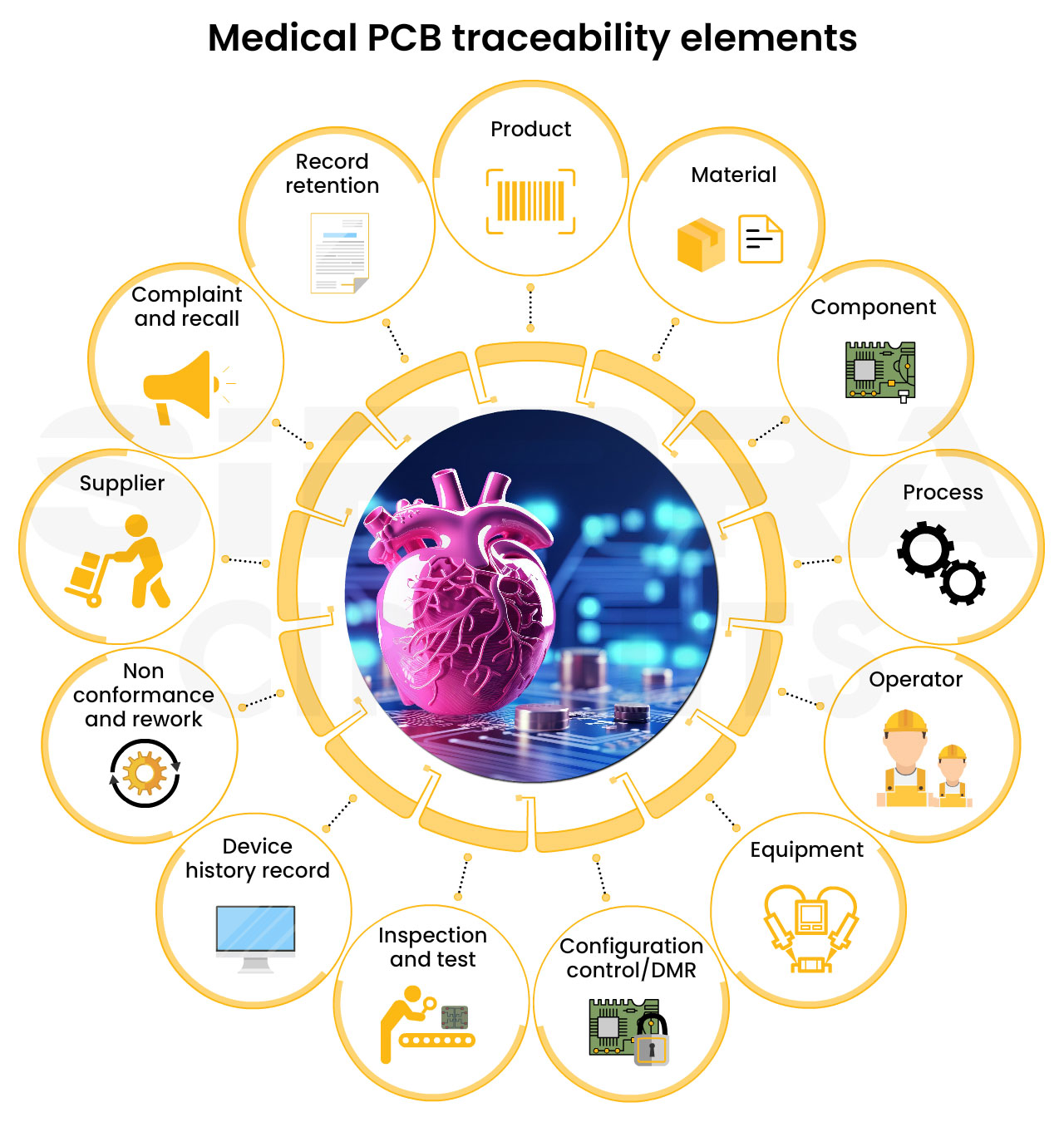
The table below outlines the primary tracking requirements and records commonly associated with medical board manufacturing.
| Traceability element | Description |
|---|---|
| Product | Each PCB/PCA shall be assigned a unique serial number, unique identifier, lot number, or batch number to enable full visibility throughout the device lifecycle. |
| Materials | Complete material genealogy, including manufacturer name, manufacturer part number, lot/date code, certificate of conformance, laminate lot, solder mask lot, surface finish batch, solder paste lot, conformal coating lot, adhesives, cleaning agents, and other production consumables. |
| Components | Track of critical and high-risk components and lot/date codes to support failure investigations, recalls, and field actions. |
| Process | Manufacturing process records, including machine programs and revision levels (CAM, SMT placement, AOI, X-ray, testing, etc.), process parameters, environmental controls, and production dates. |
| Operator | Identification of personnel who performed, inspected, verified, and approved manufacturing activities, including training and competency records where required. |
| Equipment | Identification of equipment used during manufacturing, inspection, and testing, including machine ID, calibration status, preventive maintenance records, and software versions where required. |
| Configuration control/device master record | Ability to demonstrate that each PCB/PCBA was manufactured, inspected, and tested in accordance with the approved DMR revision in effect at the time of production. |
| Inspection and test | Inspection and test results linked to the product serial number or lot, including AOI, X-ray, test, burn-in, environmental testing, and final acceptance records. |
| Device history record | Records demonstrating that the PCB/PCA was manufactured according to approved specifications, procedures, and quality requirements, supporting the medical device manufacturer’s DHR. |
| Nonconformance and rework | Records of defects, nonconformances, rework, repair activities, concessions, corrective actions, and verification results associated with the affected product. |
| Supplier | Traceability of approved suppliers, subcontractors, certifications, and purchased materials used in the product. |
| Complaint and recall | Ability to rapidly identify affected products, materials, and production lots to support complaint investigations, field corrective actions, and product recalls. |
| Record retention | Retention of tracking records in accordance with customer and regulatory requirements. Records are commonly retained for the device lifetime or for the period specified by applicable regulations and customer contracts. |
How does ISO 13485 support medical board manufacturing?
The standard defines quality system requirements for organizations involved in the design, production, and servicing of medtech devices. Traceability in PCB manufacturing requires documented processes, controlled records, process validation, and record retention to support audits, investigations, recalls, and regulatory compliance.
Manufacturers typically follow ISO 13485 guidelines when customers identify their products as healthcare devices or specify medical compliance requirements during onboarding.
To meet these conditions, fab and assembly houses maintain two sets of documentation: DMR and DHR. DMR defines how a product should be manufactured, and the DHR documents how each individual product was actually built.
Device history records vs. device master records
The table below summarizes the key differences.
| Record type | Purpose | Typical contents |
|---|---|---|
| Device history record | Documents how a specific product assembly was manufactured |
|
| Device master record | Contains approved manufacturing documentation used to build the product |
|
What are the traceability requirements for IPC class 3 builds?
IPC class 3 builds typically require manufacturers to maintain serialized production history, inspection results, process verification records, rework documentation, and quality verification activities linked to a specific product or lot.
Many class 3 boards also require cross-section analysis to verify plating quality, layer registration, hole-wall integrity, and other fabrication characteristics. Related reports and associated traceability records may need to be retained for 3-7 years after production.
Compared to lower-class assemblies, class 3 assemblies require stricter inspection workflows, tighter solder joint acceptance standards, enhanced process validation, and more rigorous quality verification procedures suitable for safety-critical electronic devices.
According to Steve Carney, R&D Project Manager at Sierra Circuits, “Customers can add traceability requirements, but they cannot alter the baseline requirements defined by IPC class 3 and other applicable standards.”
Need help in designing your circuit boards? Check out Sierra Circuits’ PCB design support. Our engineering team can help you with stack-up, layout, and DFM analysis.

What are the common traceability documents for medical and aerospace PCBs?
Board manufacturers maintain material certifications, serialized traceability records, inspection records, process verification reports, and other manufacturing records to support medical and aerospace PCBAs.
The traceability elements discussed earlier are implemented through manufacturing and quality records as listed below:
| Document/deliverable | Purpose |
|---|---|
| Certificates of conformance (CoC) | Confirms compliance with customer and manufacturing requirements, providing documented evidence for customer acceptance and audits |
| Material certifications | Document material origin, lot numbers, and supplier information to support material traceability |
| Supplier CoC and material certifications | Establish material authenticity, compliance, and traceability to approved suppliers |
| Supplier and chain-of-custody records | Track component movement through the supply chain to support counterfeit prevention |
| Serialized records | Link each assembly to material lots, manufacturing processes, inspection results, and test data |
| AOI and X-ray inspection records | Store inspection results for defect verification and traceability |
| Process verification reports | Document validated manufacturing processes and process controls |
| First article inspection reports | Establish a baseline manufacturing record for future production and configuration control |
| IPC class 3 documentation | Records compliance with class 3 fabrication and inspection requirements |
| Process failure mode and effects analysis (PFMEA) and control plans | Track process risks, controls, and corrective actions throughout production |
| DFM, DFA, and DFT review records | Document design reviews supporting manufacturability, assembly, and test readiness |
| Customer-specific reporting packages | Consolidate traceability, inspection, testing, and compliance records for customer audits |
This level of documentation enables rapid root cause analysis, supports regulatory audits, and helps manufacturers demonstrate compliance throughout the product lifecycle.
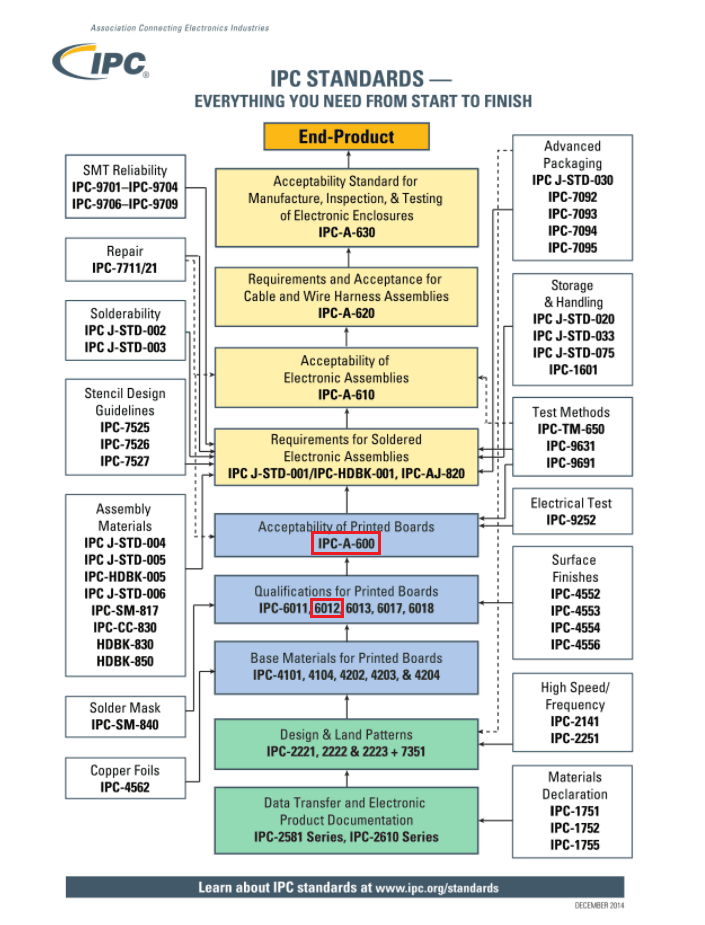
Sierra Circuits manufactures and assembles reliable IPC 6012 class 3/FS circuit boards.
To learn more, visit aerospace and defense PCB manufacturing capabilities.
What tracking records can you get from the manufacturer?
Board designers can request relevant IPC class 3 compliance documentation, AOI and X-ray inspection records, and process verification reports. Sourcing teams can ask for material certifications, supplier traceability records, and chain-of-custody documentation.
The table below outlines the key tracking records that stakeholders can request from their fabricator.
| Team/role | What engineers can ask for | Why it matters |
|---|---|---|
| PCB designers/hardware engineers |
|
Supports manufacturability, inspection visibility, and reliability validation |
| Product managers |
|
Supports compliance, customer deliverables, and regulatory requirements |
| Sourcing teams |
|
Helps verify authorized sourcing and prevent counterfeit components |
| Supplier quality engineers |
|
Supports process validation, audits, failure analysis, and quality control |
Aerospace programs may prioritize the prevention of counterfeit components and chain-of-custody documentation, while medical OEMs may focus more heavily on manufacturing history, inspection traceability, and long-term record retention.
Teams should also understand how manufacturers retain traceability records, investigate failures, contain recalls, and maintain traceability data at the lot or serial-number level.
For DFM tips, download the Design for Manufacturing Handbook.

Design for Manufacturing Handbook
11 Chapters - 96 Pages - 90 Minute ReadWhat's Inside:
- Annular rings: avoid drill breakouts
- Vias: optimize your design
- Trace width and space: follow the best practices
- Solder mask and silkscreen: get the must-knows
Download Now
How does traceability improve failure analysis in printed board manufacturing?
Traceability in PCB manufacturing helps in identifying the source of PCB failures by linking materials, components, inspections, and manufacturing history to specific assemblies. This enables manufacturers to quickly investigate failures, identify affected assemblies, implement corrective actions, and contain recalls in safety-critical applications.
Supports root cause investigations
During failure investigations, manufacturers may review lot and date codes, work orders, AOI and X-ray inspection records, rework history, and process logs.
Serial-level tracking enables them to identify the components installed on a specific board, determine the affected production batch, and review the manufacturing activities performed during assembly.
Manufacturers may also review ECOs, approved deviations, waivers, process changes, drawing revisions, and specification updates.
In medical, aerospace, and defense electronics, this information helps determine whether failures were related to materials, soldering defects, process variations, inspection gaps, or handling issues.
Enables effective recall containment and reliability analysis
Tracking systems help manufacturers isolate affected assemblies during recalls or field failures instead of broadly recalling all products. By maintaining detailed fab and component records, manufacturers can identify the boards with a specific part lot, determine the affected work orders, and distinguish isolated failures from systemic ones.
This capability is important in medical and aerospace projects where recalls can be operationally disruptive and expensive.
Traceability in PCB manufacturing supports long-term reliability analysis by helping fab houses identify recurring failure patterns, supplier-related quality issues, and process weaknesses over time.
In high-reliability electronics, this information often supports CAPA, supplier quality management, process improvement initiatives, and long-term reliability programs.</p>
Product traceability in aerospace, defense, and medical PCB manufacturing enables regulatory compliance and efficient failure analysis. By maintaining accurate material, process, inspection, and manufacturing records, board fabricators can improve product visibility and accelerate root-cause investigations.
About the technical reviewer:
Hoang Do is the Director of Quality and Compliance at Sierra Circuits. He has more than 32 years of experience in electronics manufacturing services (EMS), PCB assembly, system integration, and medical device manufacturing.
Hoang is an accomplished quality and compliance leader with expertise in AS9100, ISO 13485, ISO 9001, FDA quality system regulation (21 CFR Part 820), supplier quality management, and regulatory compliance. His technical expertise includes PFMEA, APQP, PPAP, data analytics, root cause analysis, 8D problem solving, statistical process control (SPC), Kaizen methodologies, six sigma (black belt), and risk management.
Have queries on designing your next boards? Post them on our community, SierraConnect. Our design experts will answer them.

About Pooja Mitra : Pooja Mitra is an electronics and communication engineer. With an experience of over three years in the PCB industry, she creates industry-focused articles that help electrical and PCB layout engineers.


Start the discussion at sierraconnect.protoexpress.com