



Contents

On-demand webinar
How Good is My Shield? An Introduction to Transfer Impedance and Shielding Effectiveness
by Karen Burnham
PCB material original equipment manufacturers (OEMs) such as Isola, Rogers, and DuPont develop laminates optimized for specific electrical and mechanical requirements.
These laminates are grouped into different substrate families (FR4, polyimide, PTFE) based on their resin system, dielectric performance, and intended application. Understanding the strengths of different OEMs and dielectric families helps you select the right substrate for your design.
In this article, we list major PCB laminate manufacturers and their strengths. We also discuss different printed board material families and their properties.
Highlights:
- High-speed digital laminates such as Megtron 6, Astra MT77, and Tachyon 100G are used for 56G/112G networking, AI, and server applications.
- Rogers and Taconic PTFE or ceramic-filled laminates like RO3003 and RT/DUROID 5880 are chosen for ultra-low-loss RF and microwave designs.
- Polyimide laminates from Arlon and Ventec are picked for aerospace, defense, and high-temperature applications requiring long-term thermal reliability.
- DuPont Pyralux is generally chosen for flexible and rigid-flex designs used in compact, lightweight, and dynamic electronic systems.
Who are the leading PCB material OEMs?
OEMs such as Isola, Nelco, Ventec, Panasonic, and Arlon are widely recognized for high-reliability laminates used in servers, aerospace, defense, automotive, and high-speed computing systems. Rogers and Taconic dominate RF and microwave materials, while DuPont is the industry standard for flexible and rigid-flex laminates.
The infographic below lists major PCB laminate manufacturers, their expertise, and common application areas.
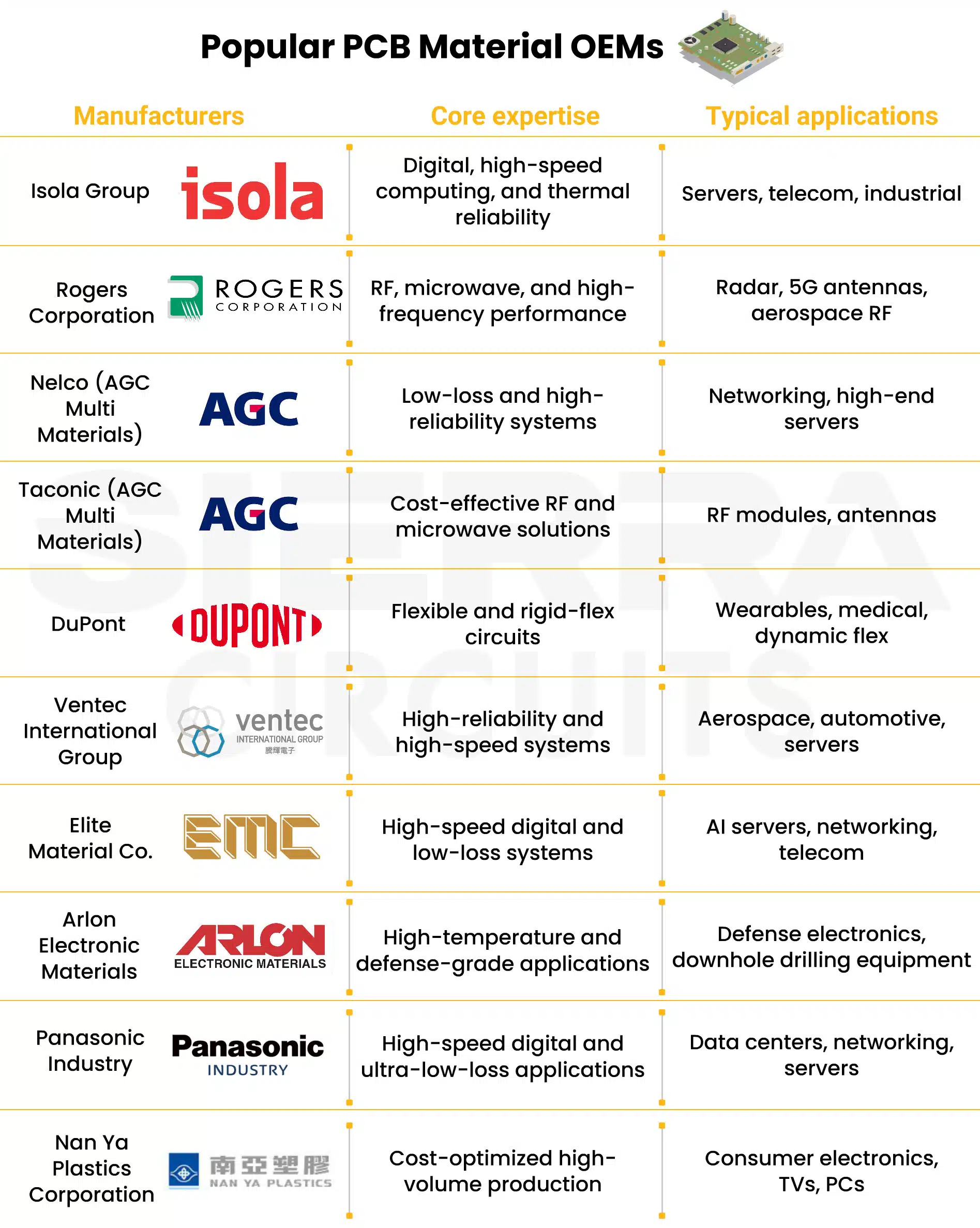
In this section, we will discuss the major PCB material OEMs, highlight their areas of expertise, and compare the features of their commonly used laminates in a table.
1. Isola Group
Isola is one of the most recognized PCB material OEMs for digital infrastructure and enterprise computing. The company offers laminate solutions across multiple material families that include standard FR4, polyimide laminates, and low-loss hydrocarbon-based systems.
Isola materials are widely used in:
-
- High-speed servers
- Telecom infrastructure
- Industrial computing
- Data center hardware
Their substrates are known for strong thermal reliability, consistent processing behavior, and robust lead-free assembly performance. Engineers often select Isola when balancing high-speed electrical performance with manufacturability and long-term reliability.
| Material name | Material type | Key properties | Typical applications |
|---|---|---|---|
| I-Speed | Low-loss epoxy laminate |
|
|
| Tachyon | Ultra-low-loss high-speed laminate |
|
|
| Astra MT77 | Ultra-low-loss hydrocarbon-based laminate |
|
|
| FR408HR | High-performance FR4 |
|
|
Among Isola’s portfolio, FR408HR remains one of the industry’s most widely adopted FR4 materials, while Tachyon and Astra MT77 target next-generation high-speed computing platforms requiring minimal insertion loss and tight impedance control.
To learn how to pick the right laminates, download the PCB Material Design Guide.
PCB Material Design Guide
9 Chapters - 30 Pages - 40 Minute ReadWhat's Inside:
- Basic properties of the dielectric material to be considered
- Signal loss in PCB substrates
- Copper foil selection
- Key considerations for choosing PCB materials
Download Now
2. Rogers Corporation
Rogers Corporation is considered one of the industry leaders in RF and microwave PCB materials. The company specializes in PTFE-based laminates (commonly known by the trade name Teflon) and ceramic-filled substrates engineered for stable high-frequency electrical performance.
These materials are widely used in:
- Radar systems
- 5G infrastructure
- Aerospace RF modules
- Satellite communications
Rogers laminates are known for extremely low dielectric loss and strong signal integrity at microwave and millimeter-wave frequencies.
| Material | Material type | Key properties | Typical applications |
|---|---|---|---|
| RO4003C | Hydrocarbon ceramic laminate |
|
|
| RO4350B | Hydrocarbon ceramic laminate |
|
|
| RT/duroid 5880 | PTFE composite laminate |
|
|
| RO3003 | Ceramic-filled PTFE laminate |
|
|
Among Rogers’ materials, the RO4000 series is widely adopted for commercial RF applications, while RT/duroid materials dominate high-end aerospace and microwave systems.
3. Nelco (AGC Multi Materials)
Nelco, now a part of AGC Multi Material, is a widely recognized PCB material OEM that offers laminates across low-loss epoxy and polyimide materials used in advanced networking and enterprise computing platforms.
These materials are widely used in:
- Enterprise networking equipment
- High-performance computing systems
- Storage infrastructure
- Telecom platforms
Their laminates are valued for low dielectric loss, stable electrical behavior, and strong reliability under thermal stress. Designers commonly select Nelco for high-layer-count digital systems requiring tight impedance control and consistent high-speed performance.
| Material | Material type | Key properties | Typical applications |
|---|---|---|---|
| N4000-13 SI | High-speed epoxy laminate |
|
|
| N4000-13EPSI | Enhanced low-loss epoxy laminate |
|
|
| N7000-2 HT | High-temperature polyimide laminate |
|
|
Among Nelco’s portfolio, the N7000 series remains one of the company’s most recognized material families for low-loss, high-reliability digital applications.
4. Taconic (AGC Multi Materials)
Taconic laminates are now a part of AGC Multi Material’s advanced PCB substrate portfolio. They specialize in PTFE and RF laminates designed for cost-effective microwave and high-frequency applications.
Taconic materials are widely used in:
- RF antennas
- Wireless communication modules
- Commercial microwave systems
- Industrial RF equipment
Their laminates are recognized for low dielectric loss, stable electrical behavior, and flexible processing characteristics. The company offers laminate solutions across multiple RF PCB material families that include PTFE woven-glass laminates and ceramic-filled microwave substrates.
| Material name | Material type | Key properties | Typical applications |
|---|---|---|---|
| RF-35 | Ceramic-filled PTFE laminate |
|
|
| TLY Series | PTFE woven-glass laminate |
|
|
| TSM-DS3 | PTFE laminate |
|
|
Among Taconic’s portfolio, the TLY series is widely recognized for microwave applications where careful PCB material selection is critical for stable RF performance and extremely low dielectric loss.
In addition to its PTFE-based RF materials, AGC Multi Material also offers the FastRise laminate family for high-speed digital and mixed RF/digital applications. Unlike Taconic’s traditional PTFE microwave laminates, FastRise is positioned toward low-loss digital interconnect and networking systems.
Pick the best materials that suit your applications with our advanced PCB Material Selector.

5. DuPont
DuPont is considered the industry benchmark for flexible and rigid-flex laminates. The OEM’s polyimide-based PCB material is widely used in dynamic applications.
DuPont materials are widely used in:
- Wearable electronics
- Medical devices
- Aerospace flex circuits
- Automotive electronics
Their laminates are known for exceptional flex durability, thin-profile construction, and strong thermal stability.
| Material name | Material type | Key properties | Typical applications |
|---|---|---|---|
| Pyralux AP | Adhesiveless polyimide laminate |
|
|
| Pyralux LF | Flexible laminate system |
|
|
| Pyralux FR | Flame-retardant flex laminate |
|
|
Among DuPont’s portfolio, Pyralux AP remains one of the industry’s most widely adopted materials for dynamic flex applications.
6. Ventec International Group
Ventec is a major supplier of high-reliability laminates for aerospace, automotive, industrial, and high-speed digital systems. The PCB material OEM offers a broad portfolio that includes high-Tg epoxy systems and low-loss digital laminates.
Ventec materials are widely used in:
- Aerospace electronics
- Automotive systems
- Industrial automation
- Server infrastructure
Their laminates are known for strong thermal reliability, consistent processing behavior, and global supply-chain support. Ventec materials are commonly selected for multilayer systems requiring reliable electrical performance.
| Material | Material type | Key properties | Typical applications |
|---|---|---|---|
| VT-47 | High- Tg FR4 laminate |
|
|
| VT-464 | Low-loss epoxy laminate |
|
|
| VT-5A2 | Thermal management laminate |
|
|
| VT-901 | Polyimide laminate |
|
|
Among Ventec’s portfolio, VT-901 materials are widely adopted in aerospace, defense, and other high-temperature electronic systems, while the company’s thermal-management laminates are commonly used in power electronics and heat-intensive systems.
7. Elite Material Co. (EMC)
EMC is a major supplier of high-performance epoxy and low-loss laminate systems used in networking, AI computing, telecom, and high-layer-count PCB applications. The company has gained strong adoption in high-speed digital infrastructure by offering substrates that balance electrical performance, thermal reliability, and manufacturability.
EMC materials are widely used in:
- High-speed networking systems
- AI and HPC platforms
- Telecom infrastructure
- Enterprise servers
Their laminates are known for low dielectric loss, dimensional stability, and reliable lead-free assembly performance.
| Material | Material type | Key properties | Typical applications |
|---|---|---|---|
| EM-528 | High-Tg low-loss epoxy laminate |
|
|
| EM-370(Z) | High-performance FR4 laminate |
|
|
| EM-888 | Low-loss epoxy laminate |
|
|
| EM-890K | Ultra-low-loss hydrocarbon-PPE laminate |
|
|
Among EMC’s portfolio, EM-528 and EM-890K are widely recognized for demanding high-speed computing applications and advanced multilayer designs.
8. Arlon Electronic Materials
This OEM is now a part of Elite Material Co., which develops products across multiple PCB material families, including polyimide and RF/PTFE laminates built for high-temperature and harsh-environment applications.
Arlon materials are widely used in:
- Defense electronics
- Aerospace systems
- Downhole drilling equipment
- Harsh industrial environments
Their laminates are known for excellent thermal stability, chemical resistance, and reliability under severe environmental stress.
| Material family | Material type | Key properties | Typical applications |
|---|---|---|---|
| 85N | Polyimide laminate |
|
|
| 49N | High-temperature low-flow epoxy prepreg |
|
|
Among Arlon’s portfolio, the 85N series remains widely adopted in defense and aerospace electronics requiring long-term performance under demanding operating conditions.
9. Panasonic Industry
The company has become one of the leading PCB material OEMs of ultra-low-loss laminates for hyperscale computing and advanced networking systems through its Megtron material family.
Panasonic materials are widely used in:
- AI servers
- Data centers
- Cloud networking hardware
- High-speed computing platforms
Their laminates are known for extremely low insertion loss, tight impedance control, and excellent signal integrity at very high data rates.
| Material | Material type | Key properties | Typical applications |
|---|---|---|---|
| Megtron 6 | Ultra-low-loss hydrocarbon-PPE laminate |
|
|
| Megtron 7 | Advanced ultra-low-loss hydrocarbon-PPE laminate |
|
|
| R-5775 | High-speed digital hydrocarbon laminate |
|
|
| Felios Series | Flexible polyimide laminate system |
|
|
Among Panasonic’s portfolio, Megtron 6 and Megtron 7 are widely regarded as benchmark materials for hyperscale computing and next-generation networking systems.
10. Nan Ya Plastics Corporation
Nan Ya is one of the world’s largest suppliers of FR4 and mid- Tg epoxy laminates for high-volume electronics manufacturing. The company focuses on cost-effective materials for mainstream PCB production.
Nan Ya materials are widely used in:
- Consumer electronics
- Desktop PCs
- TVs and displays
- Home appliances
Their laminates are known for strong manufacturing consistency, broad availability, and cost optimization.
| Material | Material type | Key properties | Typical applications |
|---|---|---|---|
| NP-155F | General-purpose FR4 laminate |
|
|
| NP-175 | Mid- Tg epoxy laminate |
|
|
| NP-612 | High- Tg laminate |
|
|
| NPG-170D | Low-loss FR4 laminate |
|
|
Among Nan Ya’s portfolio, the NP series remains widely used in mass-market electronics manufacturing due to its balance of cost efficiency, manufacturability, and reliable baseline electrical performance.
OEM selection directly impacts material consistency, supply chain stability, and fabrication yield. Always confirm laminate availability and approved equivalents with your fabricator early in the design cycle.
Sierra Circuits fabricates and assembles high-quality circuit boards in the United States. Visit our PCB manufacturing capabilities to learn more.
How are PCB materials grouped into different families?
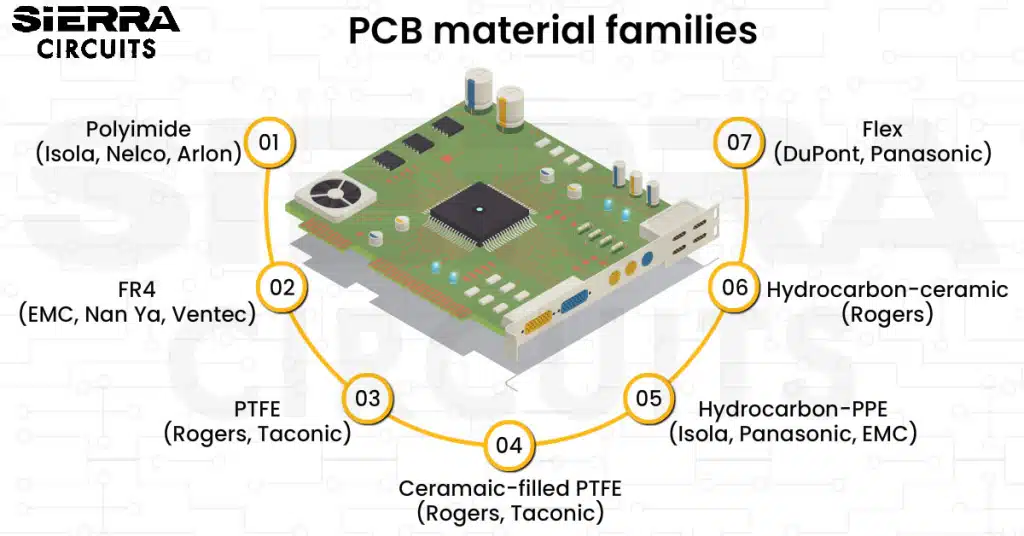
Laminates are categorized based on their resin system, dielectric performance, thermal stability, mechanical behavior, and intended application. Major laminate categories include polyimide, high-speed FR4, PTFE, ceramic-filled PTFE, hydrocarbon/PPE, hydrocarbon-ceramic-filled, and flexible laminates.
In this section, we will discuss the major printed board material families, compare their key electrical and thermal properties in a table, and highlight the important considerations to know before selecting the PCB substrate.
1. Polyimide (PI)
These are high-performance substrates specifically engineered for extreme operating environments. Polyimide laminates significantly outperform standard FR4 in high-temperature, high-reliability, and harsh-condition applications.
Key advantages:
-
- Very high glass transition temperature (250 – 260°C).
- Excellent long-term thermal stability and high Td.
- Superior mechanical strength and durability.
- Strong chemical and solvent resistance.
- Low outgassing laminates, which make them suitable for aerospace PCBs.
The table below highlights the thermal and electrical robustness of polyimide laminates.
| Material | OEM | Tg (°C) | Td (°C) | Dk (@10GHz) | Df (@10GHz) | CTE Z (ppm/°C) | Thermal conductivity (W/mK) | Features |
|---|---|---|---|---|---|---|---|---|
| P95 | Isola | 260 | 416 | 3.73 | 0.021 | 55 | 0.4 | High thermal stability |
| N7000-2HT | Nelco | 250 | 376 | 3.5 | 0.009 | 40 | 0.45 | CAF resistant |
| 85N | Arlon | >250 | 407 | 4 | 0.01 | 55 | 0.2 | High mechanical durability |
| 85HP | Arlon | >250 | 430 | 4.2 | 0.009 | 45 | 0.5 | Withstands high-temperature |
| 33N | Arlon | >250 | 389 | 4.1 | 0.01 | 53 | 0.2 | Excellent thermal and mechanical reliability |
| VT-901 | Ventec | 250 | 395 | 4.05 | 0.012 | 50 | 0.5 | Aerospace grade |
Things PCB designers and engineers should know:
- Recommended for continuous operating temperatures above 150°C (up to 200 – 220°C depending on the grade).
- Well-suited for rigid-flex, aerospace, and harsh-environment applications.
- Higher material cost, but excellent long-term thermal and mechanical reliability.
2. FR4
FR4 remains the most widely used laminated category offered by the most PCB material OEMs. They are categorized into standard high-Tg laminates and advanced low-loss high-speed epoxy systems.
High-speed FR4 offers improved electrical performance while maintaining compatibility with standard fabrication processes. These substrates bridge the gap between standard FR4 and ultra-low-loss laminates for multi-gigabit applications.
Key advantages:
- Balanced electrical, thermal, and mechanical performance across a wide range of applications.
- High-speed FR4 grades provide lower dielectric loss and improved signal integrity for multi-gigabit designs.
- Lower cost than PTFE and hydrocarbon laminates while maintaining good electrical performance.
- Compatible with existing manufacturing processes.
- Higher Tg variants improve thermal stability and reduce warpage during soldering and thermal cycling.
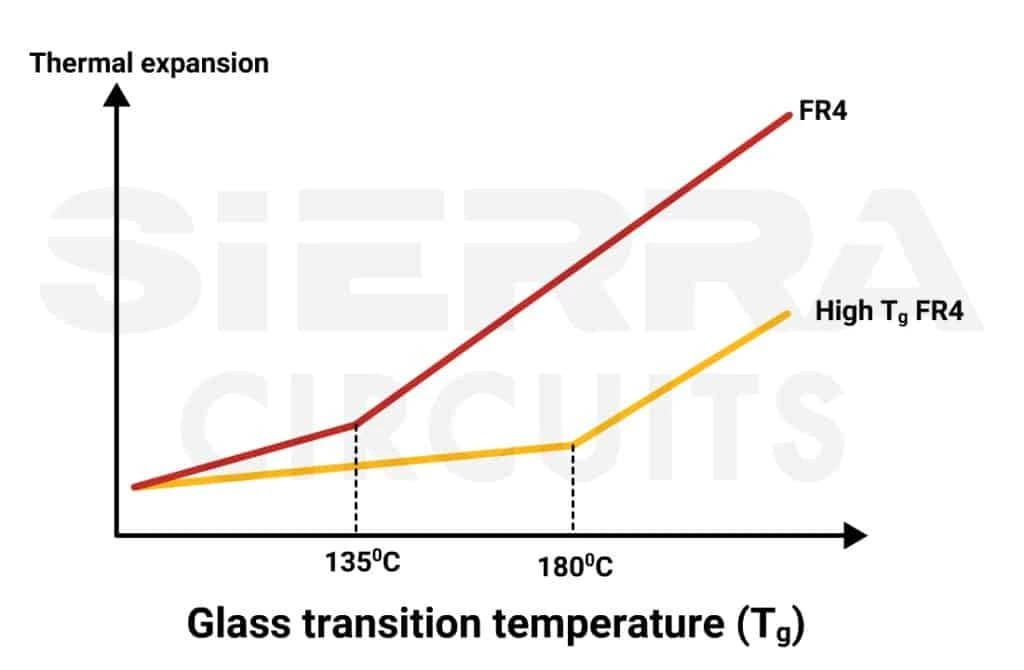
Thermal expansion behavior of standard FR4 vs. high-Tg FR4 across the glass transition temperature range.
| Material | OEM | Tg (°C) | Td (°C) | Dk (@10GHz) | Df (@10GHz) | CTE Z (ppm/°C) | Thermal conductivity (W/mK) | Features |
|---|---|---|---|---|---|---|---|---|
| FR408HR | Isola | 190 | 360 | 3.65 | 0.0095 | 55 | 0.4 | Low loss and widely adopted |
| I-Speed | Isola | 180 | 360 | 3.63 | 0.006 | 60 | 0.4 | Mid-loss and cost-effective |
| N4000-13 | Nelco | 210 | 350 | 3.6 | 0.009 | 70 | 0.35 | Balanced cost and thermal performance |
| N4800-20 | Nelco | 180 | 360 | 3.55 | 0.0075 | 27 | 0.47 | Low loss with excellent dimensional stability |
| EM-528 | EMC | 250 | 420 | 3.9 | 0.0061 | 25 | 0.6 | Ultra-high Tg, low-loss laminate with excellent thermal reliability |
| NPG-170 | Nan Ya | 170 | 350 | 4.08 | 0.012 | 30 | 0.58 | High-Tg laminate with good thermal reliability |
| EM-370(Z) | EMC | 190 | 390 | 4.2 | 0.015 | 35 | 0.58 | High-performance FR4 with stable electrical performance |
| FR370HR | Isola | 180 | 340 | 3.92 | 0.025 | 45 | 0.4 | Standard FR4 with balanced thermal reliability |
| VT-47 | Ventec | 170 | 340 | 4.27 | 0.016 | 45 | 0.5 | High-Tg laminate with strong CAF resistance |
Things PCB designers and engineers should know:
- Advanced FR4 and low-loss epoxy laminates are suitable for high-speed designs ranging from 10 to 112 Gbps.
- Provides a practical balance between electrical performance and cost.
- Compatible with conventional multilayer PCB fabrication processes.
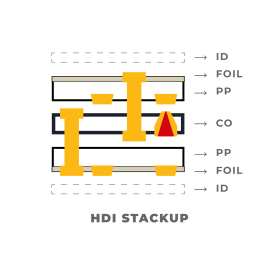
- Supports complex multilayer stack-ups for high-speed digital and networking applications.
3. Polytetrafluoroethylene (PTFE)
PTFE laminates deliver ultra-low dielectric loss and highly stable electrical performance, making them a preferred choice for RF, microwave, and millimeter-wave PCB designs.
Key advantages:
- Extremely low dielectric loss at high frequencies.
- Stable electrical performance across frequency and temperature.
- Excellent signal integrity for RF PCB designs.
- Well-suited for antennas, radar, and mmWave systems.
| Material | OEM | Td (°C) | Dk (@10GHz) | Df (@10GHz) | CTE Z (ppm/°C) | Thermal conductivity (W/mK) | Features |
|---|---|---|---|---|---|---|---|
| TLX-8 | Taconic | 553 | 2.55 | 0.0006 | 140 | 0.14 | Very low loss with easier processing |
| TSM-DS3 | Taconic | 546 | 3 | 0.001 | 23 | 0.65 | Low loss with improved thermal and mechanical stability |
| RT/DUROID 5880 | Rogers | 500 | 2.2 | 0.0009 | 237 | 0.2 | Ultra-low loss, high-frequency stability |
| TLY-5 | Taconic | ~500 | 2.2 | 0.0015 | 280 | 0.22 | Lightweight, suitable for antenna and high-speed RF applications |
Things PCB designers and engineers should know:
- PTFE materials offer ultra-low loss, making them ideal for high-frequency designs (>10 GHz).
- More challenging to process than epoxy systems and may require specialized fabrication techniques.
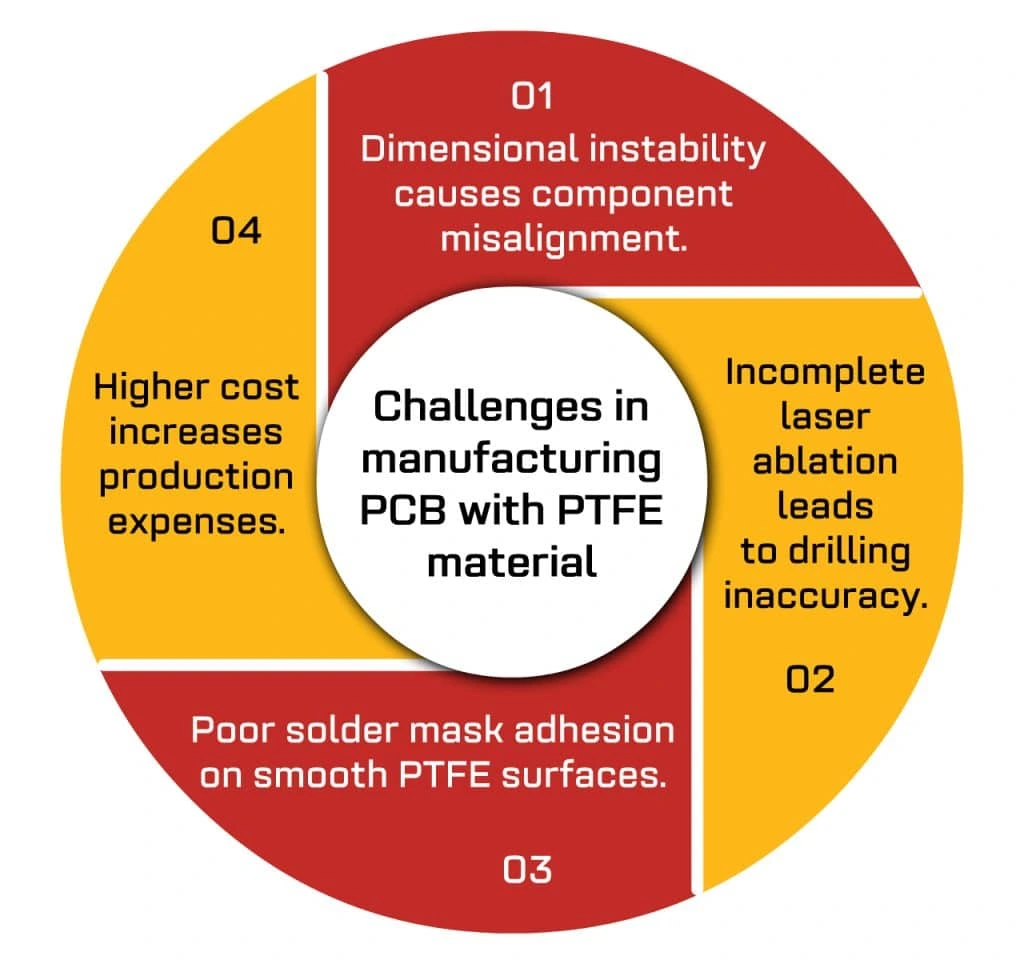
Challenges in fabricating PCBs with PTFE laminates. - Thermal performance varies based on filler content; ceramic-filled variants improve heat dissipation.
- Higher material and processing costs compared to FR4 and hydrocarbon laminates.
Also, see how to choose PCB laminates based on IPC standards to learn how IPC specifications influence material selection and PCB reliability.
4. Ceramic-filled PTFE
These materials combine the low-loss characteristics of PTFE with improved mechanical stability, dimensional control, and manufacturability.
Key advantages:
- Lower dielectric loss than epoxy-based laminates.
- Improved dimensional and thermal stability.
- Better manufacturability than pure PTFE systems.
- Suitable for high-frequency and high-power RF designs.
| Material | OEM | Td (°C) | Dk (@10GHz) | Df (@10GHz) | CTE Z (ppm/°C) | Thermal conductivity (W/mK) | Features |
|---|---|---|---|---|---|---|---|
| RO3003 | Rogers | 500 | 3 | 0.001 | 25 | 0.5 | Excellent dimensional stability and tight Dk control |
| RT/DUROID 6002 | Rogers | 500 | 2.94 | 0.0012 | 24 | 0.6 | Low-loss and optimized for high-power RF and microwave circuits |
| Isoclad 917 | Arlon | ~500°C | 2.2 | 0.0013 | 236 | 0.263 | Ultra-low-loss flexible laminate for conformal and wrap-around antennas |
Things PCB designers and engineers should know:
- Well-suited for RF, microwave, and antenna applications.
- Ceramic fillers significantly improve thermal conductivity, reduce Z-axis expansion, and enhance dimensional stability and mechanical rigidity compared to unfilled PTFE.
- Easier to process than pure PTFE laminates, but still require specialized fabrication techniques.
- Commonly used in power amplifiers, automotive radar (77 GHz), ADAS sensors, and conformal antenna systems.
5. Hydrocarbon-PPE
Hydrocarbon-polyphenylene ether (PPE) laminates provide low dielectric loss while maintaining processing compatibility closer to conventional FR4 systems. These materials are widely used in high-speed digital, AI, networking, and HPC applications.
Key advantages:
- Lower dielectric loss than standard FR4.
- Better manufacturability than PTFE materials.
- Good balance between performance and cost.
- Suitable for high-speed digital and networking systems.
| Material | OEM | Tg (°C) | Td (°C) | Dk (@10GHz) | Df (@10GHz) | CTE Z (ppm/°C) | Thermal conductivity (W/mK) | Features |
|---|---|---|---|---|---|---|---|---|
| Astra MT77 | Isola | 200 | 360 | 3.0 | 0.0017 | 50 | 0.45 | Ultra-low-loss for 112G/224G |
| Tachyon 100G | Isola | 200 | 360 | 3.02 | 0.0021 | 45 | 0.42 | Optimized for 100G+ networking |
| Megtron 7 | Panasonic | 200 | 400 | 3.61 | 0.003 | 42 | 0.42 | Ultra-low-loss platform for AI and HPC systems |
| Megtron 6 R-5775 | Panasonic | 185 | 410 | 3.35 | 0.004 | 45 | 0.42 | Low-loss for high-speed networking backplanes |
| Megtron 6 halogen-free | Panasonic | 250 | 435 | 3.7 | 0.002 | 39 | 0.37 | Halogen-free ultra-low-loss laminate |
| I-Tera MT40 | Isola | 200 | 360 | 3.45 | 0.0031 | 55 | 0.61 | Excellent thermal conductivity |
| EM-890K | EMC | 205 | 430 | 3 | 0.00254 | 45 | 0.6 | HDI material for high-speed computing |
Things PCB designers and engineers should know:
- Commonly used for 56G, 112G, and next-generation high-speed systems.
- Lower Df reduces insertion loss and improves signal integrity.
- Easier fabrication compared to PTFE laminates.
- Widely adopted in servers, AI accelerators, and networking backplanes.
- Provides a practical balance between electrical performance, manufacturability, and cost.
High-speed systems like AI servers often require embedded passive technologies to improve signal integrity and reduce routing complexity. To learn more, see OhmegaPly and TCR materials with embedded passives technology in PCB manufacturing.
6. Hydrocarbon-ceramic-filled
These materials provide a balance between radio frequency performance, manufacturability, and cost. They are widely used in RF systems that require lower loss than FR4 without the processing complexity of PTFE.
Key advantages:
- Easier to process than PTFE laminates.
- Good balance between RF performance and cost.
- Compatible with standard multilayer PCB fabrication.
- Suitable for RF and mixed RF/digital designs.
| Material | OEM | Tg (°C) | Dk (@10GHz) | Df (@10GHz) | CTE Z (ppm/°C) | Thermal conductivity (W/mK) | Features |
|---|---|---|---|---|---|---|---|
| RO4003C | Rogers | >280 | 3.38 | 0.0027 | 46 | 0.71 | Low-loss RF laminate, easy processing |
| RO4350B | Rogers | >280 | 3.48 | 0.0037 | 32 | 0.69 | Low-expansion RF material widely used in automotive radar |
| TMM Series (3,4,6,10,10i) | Rogers | >280 | 3.27 – 9.8 | ~0.002 | 20-26 | ~0.7 | Stable thermoset microwave laminate |
| RF-35A2 | Taconic | >280 | 3.5 | 0.0015 | 108 | 0.29 | Cost-effective low-loss RF laminate |
| RF-60 | Taconic | – | 6.15 | 0.002 | 69 | 0.54 | Optimized for high-power microwave designs. |
Things PCB designers and engineers should know:
- Easier to process than PTFE and compatible with standard multilayer fabrication.
- Lower dielectric loss than standard FR4 materials.
- Well-suited for mixed RF and digital designs.
- Higher thermal conductivity improves heat dissipation in RF and power circuits.
- Commonly used in automotive radar, RF modules, and microwave PCB designs.
- Lower cost than PTFE for high-volume RF applications.
For radio frequency layout strategies, download our RF and Microwave Design Guide.
RF & Microwave Design Guide
8 Chapters - 44 Pages - 60 Minute ReadWhat's Inside:
- Basics of RF and microwave board design
- Choosing RF materials
- Trace, grounding, via, and stack-up design
- Component selection and placement
- Testing and isolation requirements to avoid interference
Download Now
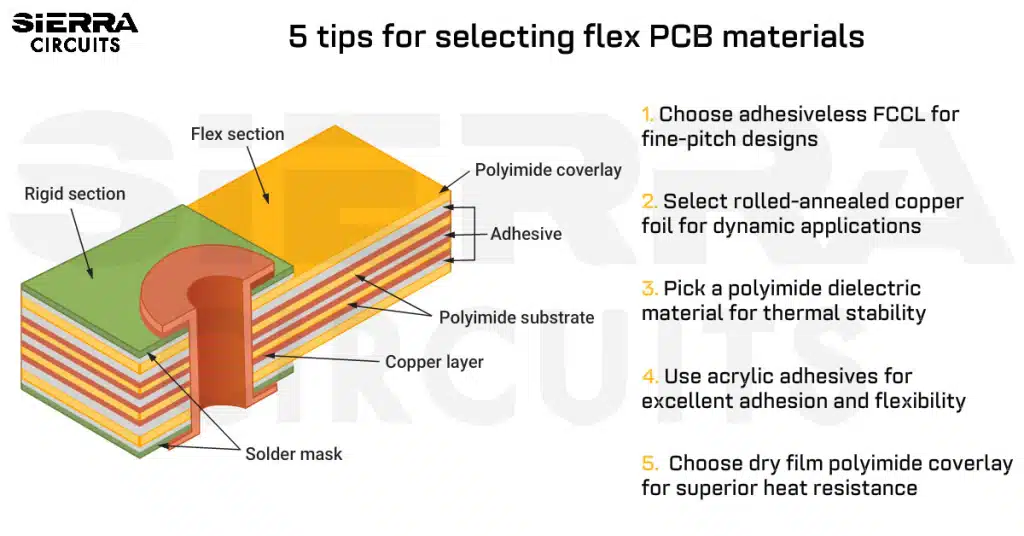
7. Flex
Flex laminates enable bending and dynamic motion while maintaining reliable electrical performance. These laminates are widely used in compact and space-constrained electronic systems.
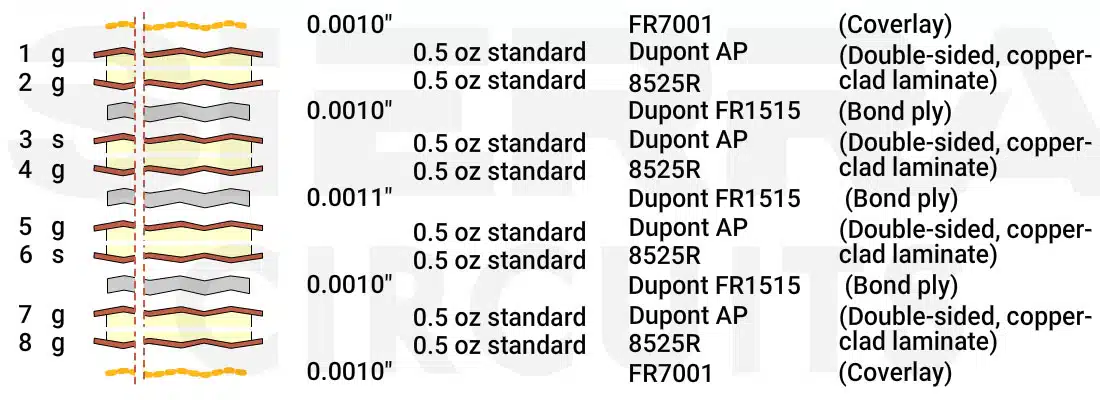
Key advantages:
- Lightweight and space-efficient.
- Supports bending and dynamic flexing.
- Reduces connectors and interconnects.
- Enables compact and complex electronic designs.
| Material | OEM | Tg (°C) | Dk (@10GHz) | Df (@10GHz) | Thermal conductivity (W/mK) | Features |
|---|---|---|---|---|---|---|
| Pyralux AP | DuPont | 220 | 3.2 | 0.003 | 0.26 | Excellent dynamic flex durability |
| Pyralux LF | DuPont | – | 3.1 | 0.015 | 0.22 | Thin profile |
| Pyralux FR | DuPont | – | 3 | 0.02 | 0.26 | Flame-retardant, UL-compliant |
| Felios R-F775 | Panasonic | >340 | 3.2 | 0.003 | 0.16 | High reliability, low-loss |
Things PCB designers and engineers should know:
- Designed for applications requiring bending, folding, or dynamic flexing.
- Reduce connectors and cable assemblies in compact electronic systems.
- Requires careful bend-radius and flex-cycle analysis for long-term reliability.
- PCB thermal management becomes a concern due to the relatively low thermal conductivity.
- Commonly used in wearables, medical devices, cameras, and mobile electronics.
- Rigid-flex designs improve packaging density and system reliability.
Need help selecting the right printed board material family for your stack-up? Our engineering team can help you evaluate material alternatives based on signal integrity, thermal performance, manufacturability, and cost before you finalize your design.
You can book a meeting with our experts or call us at +1 (800) 763-7503.
Selecting the right laminate is essential for achieving the required electrical performance, thermal reliability, manufacturability, and long-term durability. As designs move toward higher speeds, higher frequencies, and compact form factors, engineers increasingly rely on specialized PCB material OEMs’ expertise to optimize performance, cost, and reliability.
About the technical reviewer:
Pranav M. Tengse is the Team Lead for Engineering Tools R&D, Project Group at Sierra Circuits, with 5 years of experience specializing in stack-up design, PCB material selection, and designing SI tools.
Have queries on designing your next boards? Post them on our community, SierraConnect. Our design experts will answer them.

About Pooja Mitra : Pooja Mitra is an electronics and communication engineer. With an experience of over three years in the PCB industry, she creates industry-focused articles that help electrical and PCB layout engineers.

Start the discussion at sierraconnect.protoexpress.com