

Contents

On-demand webinar
How Good is My Shield? An Introduction to Transfer Impedance and Shielding Effectiveness
by Karen Burnham
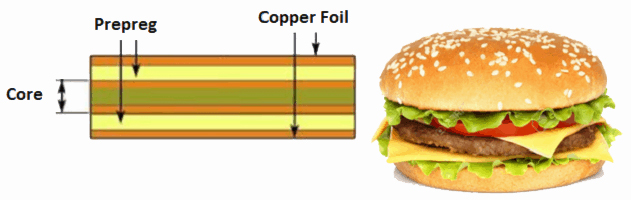
Prepreg is an insulating material used in PCB fabrication. It is made of woven fiberglass cloth impregnated with partially cured (B-stage) epoxy resin. During lamination, prepreg sheets are placed between circuit board cores or between a core and copper foil. When heat and pressure are applied, the resin melts and bonds the layers together. It also provides electrical insulation between the copper layers.
Highlights:
- Select prepreg based on dielectric spacing, impedance targets, and final board thickness requirements.
- Choose resin content (SR, MR, HR) according to copper density and topography to ensure proper void filling and interlayer bonding.
- Account for resin flow behavior during lamination, as temperature and pressure profiles directly impact bonding strength and void prevention.
- Verify resin content percentage to maintain consistency in dielectric constant, CTE, drilling quality, and pressed thickness.
- Collaborate with your PCB manufacturer early to align prepreg selection with fabrication capabilities and reliability goals.
In this article, you’ll learn how prepreg is manufactured, how resin content and flow are controlled, and how prepreg selection impacts PCB stack-up design, thickness, and electrical performance
How are prepregs made?
Prepreg is produced by impregnating woven glass fiber cloth with a controlled amount of thermosetting resin system, typically epoxy-based.
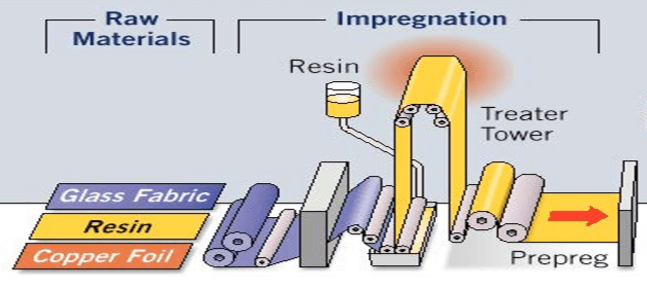
The process involves:
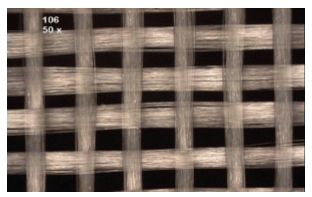
- Glass weaving: Fibers are interwoven into a fabric defined by warp and fill counts that influence how much resin the fabric can retain. The weave style determines the thickness, mechanical strength, resin absorption capability, and electrical performance.
- Resin impregnation: The glass fabric passes through a resin bath where epoxy resin is applied. Excess resin is removed to achieve a controlled resin content.
- B-stage curing: The impregnated fabric is partially cured in an oven. At this stage, the resin is partially cured to a tack-free but still reactive state.
All prepregs are B-stage materials. During final PCB lamination, the resin fully cures and cross-links.
Download the PCB Material Design Guide to learn how to pick the right laminates.
PCB Material Design Guide
9 Chapters - 30 Pages - 40 Minute ReadWhat's Inside:
- Basic properties of the dielectric material to be considered
- Signal loss in PCB substrates
- Copper foil selection
- Key considerations for choosing PCB materials
Download Now
How to choose the right prepreg for PCB and fabrication?
Prepreg selection primarily depends on target board thickness, required dielectric spacing, controlled impedance requirements, resin flow needs, glass weave style, and thermal reliability targets.
They are categorized by their resin content percentage (RC%), which determines how well the material fills the copper topography during lamination and how stable the final dielectric spacing will be. Specific percentages vary by manufacturer; the general hierarchy is:
- Standard resin (SR): Typically 40-50%. Used for plane-to-plane bonding where minimal flow is needed.
- Medium resin (MR): Typically 50-60%. For most signal layers.
- High resin (HR): Typically >60%. Essential for filling the large voids created by etched copper traces on high-density or thick-copper layers.
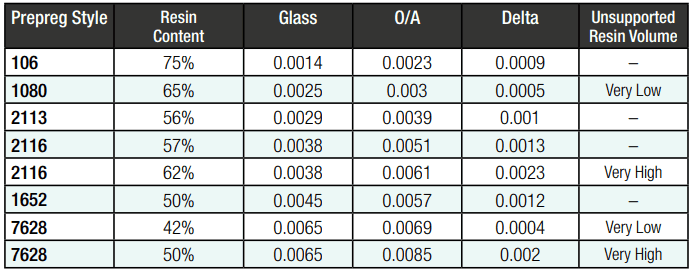
Prepregs with higher resin content flow more easily during lamination. This helps them bond layers more effectively, especially in dense PCB designs, and fill the gaps created by etched copper patterns. To achieve a specific dielectric thickness, fabricators stack multiple prepreg layers (plies) together.
How is resin content in prepreg and laminates measured?
Resin content is calculated as the percentage of resin used in the prepreg to the overall weight of the prepreg.
The method to test the resin content in the prepreg is as follows:
- Take a prepreg sample/specimen and measure the initial weight.
- Next, dip the specimen in LR grade sulphuric acid (H2SO4) for a few seconds, so that all the resin is dissolved in the acid.
- Rinse the specimen with water and dry it.
- Now, measure the weight of the specimen. The difference in weight will give you the amount of resin for a given quantity of the specimen.
Resin (%) = (Loss of weight of specimen/Original weight of specimen) x 100
Resin content decides how thick a piece of laminate will be when it is pressed. The content also has considerable effects on properties such as the dielectric constant, coefficient of thermal expansion (CTE), and drilling and etching quality.
To learn how to build an efficient PCB stack-up, download our design guide.
PCB Stack-Up Design Guide
12 Chapters - 55 Pages - 60 Minute Read
What's Inside:
Download Now
What is resin flow in prepreg?
When subjected to lamination heat and pressure, prepreg resin melts (liquefies) and flows. This behavior is called resin flow. The pressure and the rate at which the resin heats up affect the amount of flow that occurs. There is a limited period of time during which the resin remains fluid enough to flow freely, after which we say it has gelled. This is the basic principle behind the lamination process.
The actual flow of the resin is critical to the lamination operation and can be significantly impacted by laminating conditions. The amount of actual flow present will affect such properties as the interlaminar bond, bond to oxide inner layer copper foil, and bond of the laminate to ED copper foil utilized in laminate manufacture. It also affects the overall effectiveness of prepreg as a bonding sheet. Check out our article lamination voids and delamination in PCB manufacturing to study the effects of voids.
What is the difference between prepreg and core?
Prepreg is a partially cured (B-stage) fiberglass-resin sheet used to bond PCB layers during lamination, and core is a fully cured, rigid fiberglass-epoxy laminate with copper cladding for structural support. However, people often get confused between prepregs and cores due to their similarities. Allow me to clarify it for you. The core is a product of prepreg and lamination. It is more rigid compared to the prepreg.
The core is made up of a fiberglass-epoxy laminate, which meets the FR4 (Flame Retardant) grade with copper on either side. The core is usually manufactured by a core manufacturer, and the company is liable for any faults in the material that might hinder the operation of a PCB. Whereas prepregs, as described earlier, are also made of the same material as the core but are partially dried without lamination and aren’t as rigid as the core.
Another major difference between the prepreg and the core when used in a stack-up is the dielectric constant (Dk ). The Dk of the core does not vary, whereas the dielectric constant of the prepreg might change after lamination.
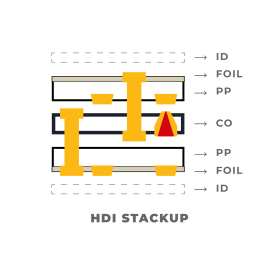

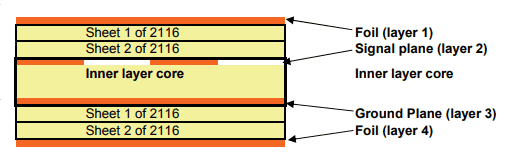
The thickness of the circuit board depends on the type of prepregs used. It must be noted that the required thickness can be achieved by a combination of prepreg plies. If you are wondering what plies are, they are nothing but thin sheets of prepregs placed on top of one another. This helps in achieving the desired thickness of the PCB.
Other than PCBs, prepregs find their applications in aerospace components, automotive parts, A/C ducting, machinery, tooling, honeycomb and foam panels, and many more.
| Feature | Prepreg | Laminate |
|---|---|---|
| Definition | Partially or uncured core material | Fully cured core material |
| Composition | Resin-impregnated cloth without copper | Dielectric base with copper foil pre-bonded to one or both sides |
| Stack-up location | Located between two cores or between a core and copper foil.- | Located between copper layers or planes. It may also form the core of the board stackup. |
| Usage | Used to bond two copper layers together or to bind one copper layer and a core while retaining separation between the two materials being bonded | A dielectric material with copper on one or both sides is used for isolation between copper layers |
| Behavior during lamination | Resin softens, flows, and cures | No resin flow |
| Thickness control | Final thickness achieved after pressing; can be stacked in multiple plies | Supplied in fixed thickness |
Prepregs are insulators that glue together cores and copper foils and assist in the manufacture of a robust PCB. Prepregs are at the heart of every circuit board, and knowledge of prepreg material is critical to PCB fabrication. A manufacturer will have to master the science of prepregs to create boards that function according to specifications.
Need assistance in selecting the right core, prepreg, and laminate for your design? Post your queries on our PCB forum, SierraConnect. Our design and manufacturing experts will help you select one.

About Rahul Shashikanth : Rahul Shashikanth is an electronics and communication engineer with over 8 years of experience in publishing technical articles on PCB design, manufacturing, and assembly. He is currently the content marketing manager at Sierra Circuits.