
EMI and EMC Design Guidelines for PCBs
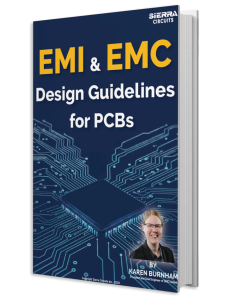
EMI and EMC Design Guidelines for PCBs by Karen Burnham explains EMI fundamentals and proven methods to minimize it.


EMI and EMC Design Guidelines for PCBs, written by Karen Burnham, provides practical guidance to minimize electromagnetic interference and achieve EM compliance in your circuit boards.
This design guide helps understand EMI at its source and address it early in the design phase rather than relying on last-minute fixes.
The initial chapters explain how switching operations, PWM signals, and motors generate high-frequency noise, and why fast edge rates and discontinuities increase radiation.
The EMI and EMC design guide also examines common PCB structures (ribbon cables, loops, apertures, and poorly bonded components) that unintentionally behave as antennas.
The final chapter presents layout and stack-up strategies for achieving electromagnetic compatibility. It covers transmission line design for field containment, routing practices to reduce coupling, solid reference plane implementation, stitching vias at layer transitions, filtering techniques for conducted emissions, and shielding methods to confine EM fields.
By applying the best practices provided in this eBook, engineers and product developers can proactively control noise and significantly improve the likelihood of passing EMC tests on the first attempt.
What’s inside:
- How electromagnetic interference is generated and spreads
- How to identify EMC requirements and applicable standards
- How to design for electromagnetic resilience
- Common EMI sources: Switching circuits, PWM signals, and motors
- PCB structures that cause radiated emissions
- Practical layout, stack-up, filtering, and shielding guidelines